
What Is Institutional Cooking? A Rewarding Culinary Career Outside of Restaurants


For many chefs, cooking at Noma is the dream job. This was certainly true for Dan Giusti, the former head chef of the lauded three-Michelin starred eatery that made five appearances in the number one spot on the annual World’s 50 Best Restaurants list.
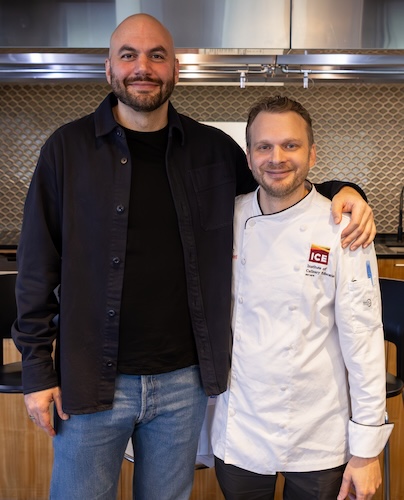
Giusti reached a level many cooks spend their entire careers pursuing. Then, in 2016, he left his position as Noma’s head chef and founded Brigaid, a nonprofit dedicated to improving food systems in schools and community organizations. Nearly a decade later, that mission remains his focus.
Recently, Giusti visited the Institute of Culinary Education for a conversation with Senior Vice President of Culinary Operations Barry Tonkinson. Here, he explained why he believes institutional cooking is one of the culinary industry’s most important — but overlooked — career paths.
🔈 Listen to Dan’s live stream at the Institute in NYC.
What Is Institutional Cooking?
Institutional cooking refers to large-scale food service programs in schools, hospitals, senior centers, prisons and other community settings where culinary teams prepare meals for hundreds — sometimes thousands — of people each day.
Unlike restaurant kitchens, institutional foodservice prioritizes scale, consistency, logistics and nutrition while operating within strict budgets and regulations.
For decades, many chefs viewed institutional food as separate from “real” culinary work. It’s a perception Giusti says must change.
“I wanted to cook for more people,” Giusti told culinary school students during his visit.
Why Dan Giusti Walked Away From Fine Dining
At Noma, Giusti oversaw one of the world’s most celebrated kitchens, where roughly 45 chefs prepared meals for the world’s most discerning diners. The pressure was immense.
“Every person who came in was looking for it to be the best meal they’ve ever had in their life,” he explained.
Over time, Giusti began reevaluating his definition of success. Instead of cooking for a small number of diners at the highest level, he became increasingly interested in scale and long-term impact.
“I wanted to cook for people who really needed the food,” he said.
That realization led him to institutional cooking — not because he disliked restaurants, but because he saw an opportunity to apply professional culinary systems in places where meals directly affect daily life.
Inside Brigaid’s Mission
Founded in 2016, Brigaid places professional chefs in schools and other institutions to improve food quality, kitchen systems and operational efficiency.
The organization works with school districts, senior centers, nonprofits and correctional facilities across the country.
Rather than replacing existing cafeteria staff, Brigaid chefs work alongside them — helping implement culinary systems, improve recipes, streamline operations and build kitchen infrastructure.
Giusti explained that many school food programs operate with extremely limited budgets, often leaving roughly $1.70 per meal for ingredients after federal reimbursement requirements are met. Many kitchens also lack proper equipment, systems or culinary training.
“We’re not reinventing the wheel,” Giusti said. “We are introducing best practices.”
These best practices include everything from labeling and organizing to establishing production systems and communication workflows.
A Different Kind of Culinary Career
Giusti challenged the idea that culinary success only exists inside Michelin-starred restaurants.
While institutional kitchens lack the prestige traditionally afforded fine dining, he argued that they provide something much more fulfilling : impact, stability and leadership opportunities.
Additionally, Brigaid chefs can earn competitive salaries with benefits — a compensation package that remains relatively uncommon in much of the restaurant industry.
More importantly, Giusti believes institutional food develops chefs in different ways.
“You might need to present it to the school board,” he said. “You might need to articulate why we’re doing what we’re doing.”
The work requires organization, communication, systems thinking and relationship-building at scale.
“Institutional food definitely is a place where you can learn a lot,” he said.
Why Conversations Like This Matter for Culinary Students
At the Institute of Culinary Education, students regularly hear from chefs working across every corner of the food industry — from Michelin-starred restaurants to nonprofit organizations, hospitality groups and emerging culinary sectors.
Giusti’s visit offered students a broader view of what a culinary career can look like.
“Success now is completely different,” he said. “For me, it’s all about impact.”
And for many students entering today’s culinary industry, that definition may resonate now more than ever.