

What is Food & Beverage Management? Answers To Your Career and Training FAQs


Not all culinary careers start or stay in the kitchen.
In fact, many culinary school graduates actually studied wine, restaurant entrepreneurship or travel and tourism — and many of these graduates seek front-of-house roles, wherein operations, service and strategy are as vital to the guest experience as the quality of the cuisine.
Food and beverage (F&B) management sits at the center of this work, blending hospitality, business and leadership across a wide range of settings. Below are some of the most frequently asked questions about food and beverage management.
What does food & beverage management cover?
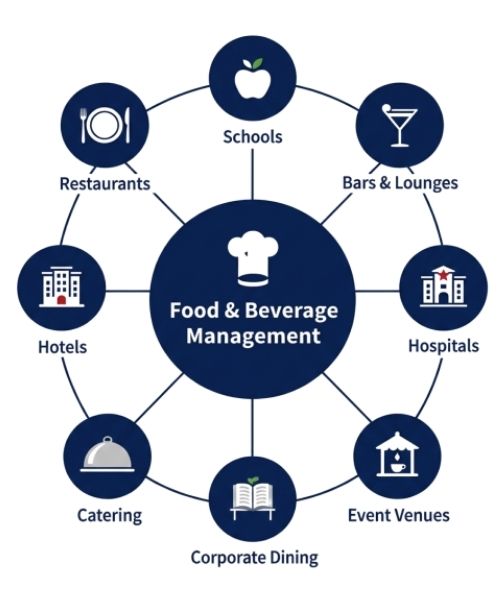
Food and beverage management relates to the operation of businesses that serve food and drink — restaurants, bars and hotels, as well as hospitals, schools, corporate dining programs and event venues.
The field is broad, but its core objective is simple: deliver exceptional guest experiences while running an efficient, profitable operation.
What You Can Learn (Hint: It’s Not Just Hospitality)
F&B management programs are designed to build both operational and business fluency. Our Restaurant & Culinary Management program covers key areas including:
- Concept development and menu design
- Culinary marketing
- Food safety
- Purchasing and cost control
- Staff management
- Legal and regulatory basics
- Service management
- Finance and accounting
- Beverage and wine management
- Facilities and design
Together, these topics provide insights to how food businesses run — from the kitchen line to the balance sheet.
📕 Related: Understanding Restaurant Food Safety
Career Paths: From Floor Manager to Director-Level Roles
Graduates can pursue roles like floor manager and general manager in restaurants, bars and hotels — but that’s just the starting point.
Many specialize in areas such as:
- Beverage or wine direction
- Service leadership
- Operations management
At the group level, larger hospitality companies often have roles like director of operations or director of restaurants. Typically, these roles oversee multiple teams across several locations, combining logistics, leadership and big-picture strategy.

Do chefs need management training?
For aspiring chefs, F&B management can be a career accelerator.
Understanding pricing, staffing, administration and customer experience can help chefs move beyond execution and into entrepreneurship.
Even in kitchen-focused roles, executive chefs are often deeply involved in budgeting, menu strategy and team management.
What about career changers?
Many culinary students come from other industries, often with prior management experience.
F&B management programs are designed to provide:
- Hospitality-specific operational knowledge
- Insight into restaurant and service workflows
- Exposure to industry trends and regulations
- Networking opportunities within the field
For career changers, it’s less about starting over and more about translating existing skills into a new environment.

Why pair food and beverage management with culinary training?
Culinary and management skills are closely linked. Understanding both sides of the business (kitchen and front-of-house) can yield more long-term growth potential.
According to the U.S. Bureau of Labor Statistics, employment of food service managers is projected to grow in the coming years, driven by continued demand for dining and hospitality experiences.
The Institute offers a Dual Diploma discount that allows students to combine culinary or pastry training with Restaurant & Culinary Management, studying both technical and business components.
For anyone looking to lead in the industry — whether from the dining room or the kitchen — the knowledge and skills covered in these programs can support a variety of career paths.
📗 Related: How I Used My Culinary School Education Outside of the Kitchen