
What Is a Saucier — and Why Is This an Essential Restaurant Kitchen Role?


Want to be a sauce boss? In professional kitchens, the role of saucier requires strong technical skills and culinary experience. Understanding emulsification, fond, reduction, and temperature control is a wise first step.
“All good restaurants have sauce on the menu,” says ICE Lead Recreational Chef Samantha Landwehr.
A good sauce can elevate a dish by enhancing flavor; adding contrast or balance; or tying together the elements on a plate. As for the saucier who makes it, a good sauce demonstrates culinary prowess.
Four cooking concepts serve as the foundation for sauce making: emulsification, fond, reduction, and temperature control.
Culinary Arts and Health-Centered Culinary Arts students at ICE study the science behind these skills and practice them throughout their programs. (There are even sauces in Pastry & Baking Arts, if ganache and custards are more your speed.)
Dive into the role of the saucier and the skills needed for the job — plus our recipe suggestions to help you practice – below.
What is a Saucier?
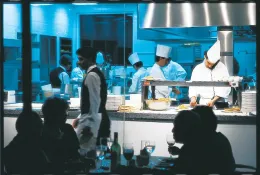
The saucier is the chef in a restaurant responsible for making sauces. The work requires a high level of technical skill. They must be able to manipulate flavor, texture, and consistency — the components of a sauce that can bring a dish to life.
A saucier may also be responsible for sauteed items, as these and their cooking processes contribute to the sauce-making process.
“In fine dining and Michelin-starred restaurants that utilize the traditional kitchen brigade, the saucier sits under the executive and sous chef,” explains Chef Sam.
“In more casual restaurants, the position may be split up amongst different stations. It could be someone who works on the cold line, or a couple of the hot line cooks, so that the sauces are still covered,” she shares.
4 Key Techniques for Sauces
Emulsification, fond, reduction, and temperature control comprise the backbone of sauces. It’s crucial that a saucier understands these culinary concepts and can execute them correctly.
Emulsification
“Emulsification is the process of combining two ingredients that don’t naturally mix,” says Chef Sam.
Take oil and water, for example. When poured into the same container, the two liquids separate into distinct layers and do not mix. Emulsification, then, is the process of combining them.
Chef Sam explains how physical activity (like blending and whisking) and the use of emulsification agents (like mustard and mayonnaise) adhere ingredients and help them stay together longer.
Her recipe for balsamic vinaigrette illustrates these concepts with oil and vinegar, and is a great starting point for understanding this technique.
Fond
Fond is the flavor base for some sauces. It is the browned bits stuck onto the bottom of the pan after searing proteins or vegetables — and it is filled with umami.
In addition to understanding fond, a saucier needs to make it (by correctly searing ingredients) and incorporate it into sauces (through a process called deglazing).
Try Chef Sam’s recipe for chicken pan sauce, which dives deep into these concepts — and get her pro tips for avoiding burning fond (a common issue for home cooks).
Reduction
How do sauciers achieve the desired consistency for a sauce? There are a variety of methods. One is to use thickening agents, like cornstarch and tapioca starch; another is through reduction.
Reducing a sauce, done by simmering, thickens the texture and concentrates the flavor.
This technique is crucial in the same chicken pan sauce recipe from Chef Sam. “This pan sauce doesn’t contain a thickening agent, like cornstarch or flour, so it’s important to be patient and allow it to reduce properly to achieve the desired mouthfeel and flavor,” she says.
This recipe can be adapted for turkey, so practice this technique during the holidays.
Temperature Control
A saucier needs to be aware of temperature while cooking and holding sauces for service.
Too high a heat can lead to burnt fond (which adds bitter flavors) and over-reducing (which can be course corrected but takes precious time).
In Chef Sam’s recipe for bearnaise, a classic French sauce made mostly of butter and egg, temperature is key in three ways:
- The egg needs to be gently cooked over a double boiler — too high a heat leads to curdling and off textures.
- If the egg and butter are not the same temperature, it will be harder (or impossible) for them to emulsify.
- The finished sauce must be kept warm for service — too hot or too cold, and the emulsion will break.
This means that a saucier must be knowledgeable about how temperature affects sauce — and be able to control it while making and managing multiple sauces simultaneously.
To practice temperature control, try Chef Sam’s recipe the next time you make steak or want to elevate grilled vegetables.
From Basic to Boss
Use Chef Sam’s recipes as a guide to practice emulsification, fond making, reduction and temperature control, to gain experience with the building blocks of sauce-making.
With an understanding of these foundational techniques, you can swap the ingredients to make your own sauces.
Even if you aren’t interested in working as a saucier, these techniques can expand a culinary arsenal and level up your skills as a private chef, food writer, or restaurateur.