
Sauce-Making 101: How to Make Emulsified Sauces — and a Recipe!

Sauces are essential to most every dish professional chefs make. Among home chefs, however, they are often given short shrift (in favor of the more razzle-dazzle aspects of a dish).
To address this, we've curated a series of three recipes that teach the skills and techniques behind three foundational sauces in a progressive, "layered learning" framework.
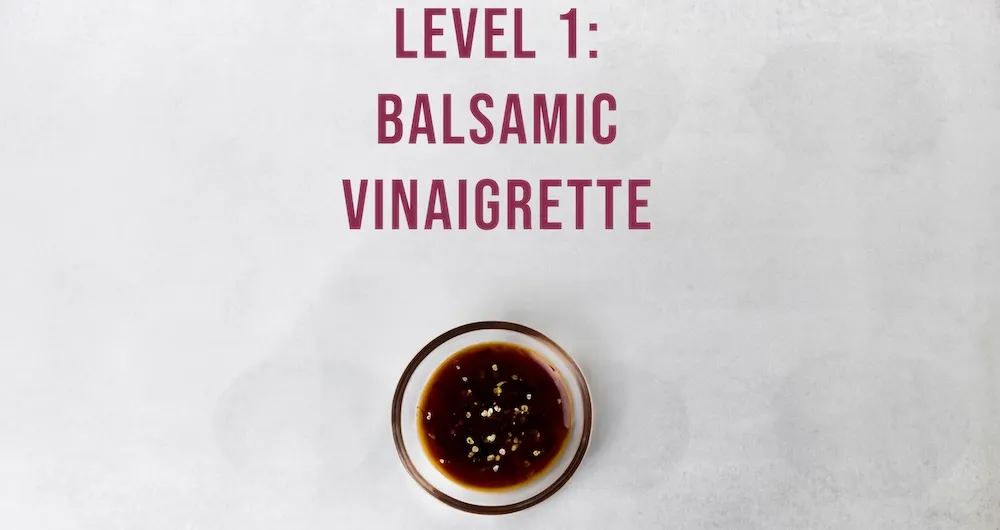
Here, we're focusing on emulsification, one of the building blocks of sauce-making, and explaining how it's used to make our level one sauce, balsamic vinaigrette.
What is emulsification (and why is it important)?
Emulsification is a skill you need to nail for making sauces, though its applications extend throughout culinary and pastry kitchens. Culinary Arts, Health-Centered Culinary Arts and Pastry & Baking Arts students at ICE all practice this technique throughout their programs.
“At the basic level, emulsification is the process of combining two ingredients that don’t naturally mix,” explains ICE Lead Recreational Chef Samantha Landwehr. Oil and vinegar are a perfect example of such ingredients.
How to Emulsify Balsamic Vinaigrette
Constant physical activity, like whisking and blending, forces these naturally separating ingredients to combine.
In balsamic vinaigrette — which is comprised mainly of oil and vinegar — the oil is slowly streamed into the vinegar mixture while whisking vigorously and consistently.
“Microscopic droplets of oil are easier to mix in with vinegar,” says Chef Sam. “If you dump all the oil in at once, the fat molecules can’t break up enough to be incorporated.”
Emulsifying Ingredients
Balsamic vinaigrette is an example of what is called a semi-permanent emulsion; the ingredients mix but separate over time. (This is why you always shake salad dressing before using.)
According to Chef Sam, some ingredients act as emulsifying agents (i.e., ingredients that help naturally-separating liquids stay mixed for a longer time). Here, the emulsifying agent is Dijon mustard.
Other Emulsified Sauces
Emulsifying doesn’t always result in aching wrists and tired forearms (from all that whisking). Chefs often replace manual emulsification with machine emulsification, using blenders and food processors to make foundational sauces.
Pesto is one example of an emulsified sauce made with the help of a machine (versus entirely by hand). When making pesto, the oil is slowly streamed into a running food processor to mix with the other ingredients (like basil, cheese, and nuts) and produce a cohesive sauce. Pesto uses the same science as balsamic vinaigrette, but it incorporates more ingredients and yields a completely different sauce texture.
Try Your Hand (Literally) at Balsamic Vinaigrette
Learning how to properly emulsify, starting with this easy dressing, is the bedrock of learning how to make more advanced sauces.
“This balsamic vinaigrette recipe is a kitchen staple for the home cook,” says Chef Sam.
Plus, it’s easy to put your own twist on the dressing. Chef Sam suggests playing with the vinegar (try any acidic ingredient, like another type of vinegar or citrus juice) and the sweetener (like agave or maple syrup) as a starting point. Just make sure to follow the basic formula of one part acid to three parts oil.
Sauce-making can include multiple culinary techniques, so once you get the hang of emulsifying, you’re onto the next level!
Ingredients
- 1 shallot, minced
- ⅓ cup balsamic vinegar
- 1 tablespoon Dijon mustard
- 1 tablespoon honey or maple syrup
- 1 cup olive oil
- Salt and pepper, to taste
Directions
- In a medium bowl, add shallot, balsamic vinegar, Dijon, and honey. Whisk to combine.
- Slowly stream in olive oil while, whisking constantly to emulsify the two liquids. When all the olive oil has been incorporated, vinaigrette should be a homogeneous mixture.
- Adjust seasoning to taste with salt and pepper.