
[VIDEO] Chef Sohui Kim, Alum and James Beard Favorite, Shares Recipes and Industry Lessons


Chef Sohui Kim, an Institute of Culinary Education 50th anniversary distinguished alumni honoree, a two-time James Beard Award nominee, and the Executive Chef-Partner-Owner of Insa and Gage & Tollner, both in Brooklyn, recently returned to our New York campus to teach three recent grads how to make Korean Steak and Eggs — and she let us film it as part of our "Back to Culinary School" series of videos.
In the video, she shares her family food story, gives tips for making proper fried rice, and offers professional advice for culinary school alumni at the start of their careers.
Watch the videos below — both the “Back to Culinary School” cooking class and a Q&A with Chef Sohui on her favorite culinary school lessons and memories — then scroll for extra insights and hot takes from Chef Sohui.
(But before you do, here’s a hot take from us: Grab a tissue. Chef Sohui’s warmth and wisdom is not just inspiring, it’s oddly heartwarming — as evidenced by the reverie the students in the video have for her.)
So Who's Who?
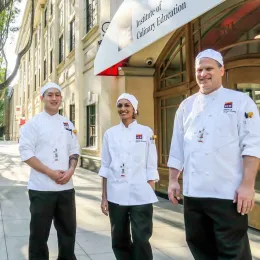
Chef Sohui’s “Back to Culinary School” class features three culinary school alumni.
- Christiana Fiorello is a private chef in Vermont.
- Amanda Lee is the special events director at ICE.
- Alessandra Ciuffo is a culinary influencer who rose to IG and TikTok prominence with her "Day in the Life of a Culinary School Student" reels.
Food Love Runs in the Family
Cooking, according to Chef Sohui, is in her DNA. In the “Back to Culinary School” video, she recalls cooking beside her mother and grandmother.
“I grew up in a very traditional Korean family,” she says, “where food is everything.”
This resonated with the students.
Fiorello, who was particularly moved, tells Chef Sohui: “My first memories were in the kitchen with my grandma, so being around [family] … It’s my culture. I’m originally from Greece and Sicily, so our family is all about food. Every Thursday and Sunday, we were in the kitchen, about 30 or 40 people. We had a small kitchen, but we made it work … This is what drives me.”
5 Hot Takes From Chef Sohui
- Use cold rice to make fried rice. “Maybe day old rice,” she says. “You know? The rice that’s sort of forgotten for a day or two in the back of the fridge. That’s the best rice to make fried rice with.” Side note: Chef Arnold Myint offered the same advice when he visited the school last month and regaled students with an “All About Rice” cooking demonstration in partnership with the Thai Embassy.
- If your marinade includes sugar — as Chef Sohui’s does thanks to honey and apple — watch your steaks on the grill closely so their sugars don’t burn your steak.
- Rest your steak 5 to 7 minutes so that all the juices rest and circulate.
- To get perfect grill marks, give your steaks 1.5 minutes to cook… then “do the twist,” aka quadrillage.
- To those just starting out on their culinary career journey, she espouses intentionality, noting that often, those who gravitate to cooking want things to happen quickly. “There’s a certain amount of taking it slow,” she says, “having patience with yourself, making sure that you understand the techniques and the ingredients, and just being a little easier on yourself, because it’s a hard industry.”
Why ICE?
When assessing the merits of culinary school, Chef Sohui knew she wanted to train in a culinary capital. It’s one of the reasons for choosing ICE’s New York campus. (There is also a campus in LA.)
Lee agrees. Explaining why she chose the school, she says, “We all know that New York City is where it’s at, with all the connections that you can build here, and the food and the culture — it was exactly what I was looking for.”
A Fork In the Road (Translation: A Change In Career)
“I went to ICE back when it was called Peter Kump’s cooking school,” says Chef Sohui, noting that she “didn’t make the choice lightly” because she already had an established career in architectural publishing.
“But when I did,” she says, “I knew that I found the right place because of the quality of the professors.”
She also was clear about enrolling in the school’s dual diploma program: “The benefit of both programs — obviously culinary arts to learn the techniques, spending many hours on knife skills as well as getting to know various ingredients and learning from the various teachers and their styles — but the management program definitely was an eye opener in terms of how a restaurant functions.”
This foundational operations experience proved vital. Chef Sohui currently owns two restaurants, Insa and Gage & Tollner, both in Brooklyn.
James Beard Award Nominations
Chef Sohui has been nominated for two James Beard Awards. Her first nomination was for Best Chef: New York (for her work at Insa in 2019). Her second was for Best Chef: New York (for her work at Gage & Tollner in 2023).
She considers these nominations “the greatest recognition from your peers.”
Is Culinary School Worth It?
“I look back at my experience at ICE really fondly,” says Chef Sohui, noting that she still keeps in touch with many of her classmates.
“Being an ICE alumni is part of being part of a huge family,” adds Fiorello. “You are always connected everywhere.”
As to whether or not culinary school is “worth it,” Chef Sohui is clear on its value to her. “Having started the journey a little later than most people who enter this business, I think it gave me a real leg up,” she says.
“And whenever I was in between jobs, I was right back at the school and looking at the job boards and running into people that I knew.”
Now on the side of the employer — versus the job-seeker — she looks for applicants with culinary school training.
“There certainly is a difference in the foundational knowledge that they come to the restaurant with. When I look at a resume … as an employer looking for cooks, it’s like 'okay they went to this [culinary] school,' and I can assume they have a base knowledge.”
“Does that play off better than somebody who just has a few restaurant experiences?” she asks. “I think it does.”
Advice to New Culinary Professionals
“My top advice,” she says, “is to make sure that [your] heart is in it.”
She recommends asking yourself two key questions: First, ‘How much do you love cooking?’ Next, ‘How much do you love people?’
“Because at the end,” she says, “it’s culinary arts meets hospitality.”
* Experience varies by student, with outcomes contingent on factors including graduate aptitude, job market, place of residence and work history, among others.