
Vital Names: Long Before Stonewall, "The Gay Cookbook" Was Out and Proud

Welcome to “Vital Names,” a series of articles spotlighting influential chefs and culinary landmarks whose names are not as widely known as they should be, and whose impact on America’s foodways has been overlooked, misattributed or appropriated. Throughout June, to mark the world’s annual observation of Pride Month, we honor the LGBTQIA+ community.
Raise your hand if you know the name Lou Rand Hogan. Don’t worry if your hands are in your lap. You’d only be outnumbered in a room of gay culinary historians.
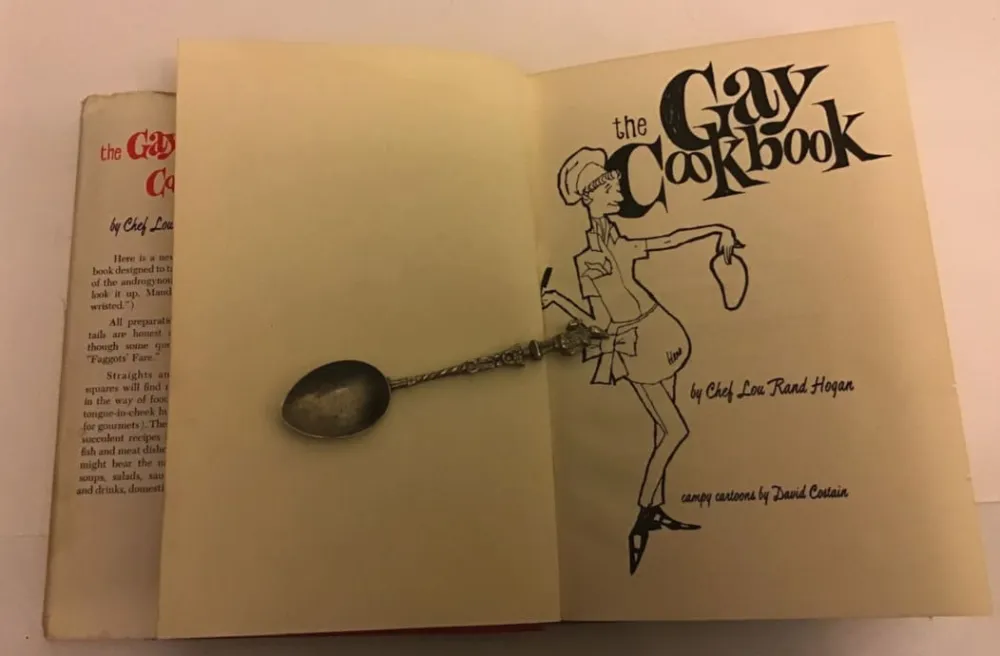
That’s because Lou Rand Hogan was what is often referred to as “before his time.” In 1965, he wrote the first openly queer cookbook published in the United States. Titled “The Gay Cookbook,” its contents, to quote the author, represented a “complete compendium of campy cuisine and menus for men … or what have you.”
Today, this description is unremarkable. After all, what controversy could men cooking stoke? But when you consider the socio-political backdrop of the 1960s – Barry Goldwater, Vietnam, “Bloody Sunday” on the Edmund Pettus Bridge — it’s easy to understand why Lou Rand Hogan and “The Gay Cookbook” were revolutionary.
History, Culture and Culinary Context
“The Gay Cookbook” was published in 1965, four years before the Stonewall Uprising that launched the gay liberation movement (and that Pride Month has commemorated every year since).
At the time, The American Psychiatric Association (APA) deemed homosexuality a mental disorder — this was reversed in 1973; equal rights for gay men and women were an inconceivable Xanadu, to say nothing of marriage parity and legislative advocacy; and media representation was non-existent.
Gay justice groups like the Mattachine Society did exist, and small-scale protests like Philadelphia’s “Annual Reminders” were being staged to demand fair treatment, but edicts like the 1873 Comstock Laws, which prevented “obscene” material — defined as anything related to sex — from being distributed by mail, continued to inform and entrench narrow American ideologies around gender roles.
As historian Steven Vider wrote in a 2013 American Quarterly article, “Social scientists, journalists, and filmmakers of the 1950s typically depicted gay men as outsiders, if not threats, to the ideal heterosexual household.” Against this backdrop, simply portraying gay men as happy in their own homes was a radical act.
The Times They Are a-Changin’
The year before publication of “The Gay Cookbook,” Bob Dylan’s “The Times They Are a-Changin” hit radio waves. With regard to gay representation, the song’s title could not have been more apt.
By the early 1960s, a series of court cases had begun to redefine obscenity. This change meant that, among other things, books and magazines centering gay people, which were illegal to distribute under the Comstock Laws, would no longer be seized and destroyed.
As a result, “gay lit” proliferated. In its 1964-1965 catalogue, The Guild Book Service, a gay mail-order catalogue, featured more than 100 titles, including those by William Burroughs and James Baldwin.
Advertising followed suit. To promote “The Gay Cookbook,” Doubleday Book Shop purchased a quarter-page ad in the New York Times showing a trim, dapper man in a floral print apron dangling a raw steak over a grill. It was an image of the book’s cover, and the caption indicated “30 riotous drawings [that] add spice to every chapter.”
Campy, Cheeky and Smart
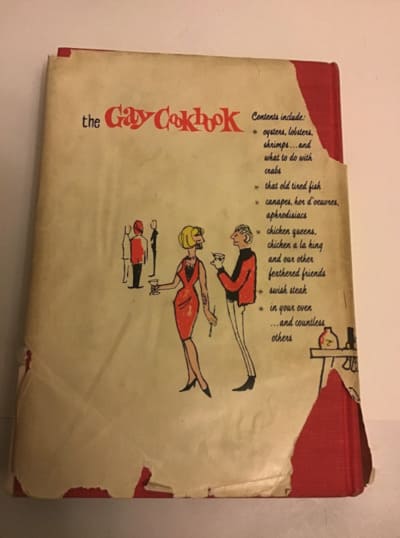
As the Doubleday advert claimed, the book’s art was indeed riotous and spicy. The back cover showed partygoers — one in a shift dress sporting an obvious five o’clock shadow — laughing with cocktails in hand. Inside, chefs danced on tables, fished for mermen and did the cancan in ruffled costumes.
Hogan’s writing was the same. Known for his mastery of the double entendre, his copy is cheeky and sophisticated, his recipes long and chatty. Female nicknames, a significant part of mid-century camp conversation among gay men, appear often, among them Mary, Mabel, Myrtle and Mame.
But for all of its whimsy and humor, the book’s writing and drawings are equally complex and cosmopolitan. Hogan’s recipe repertoire includes American and French classics, as well as Hawaiian, Southeast Asian and Mexican fare. He explains the preparation of a multi-course Indonesian banquet with roots in Dutch colonialism (known as a rijsttafel) and offers a chili recipe that spans several pages and requires nearly four hours of cooking.
Conversely, Hogan was acutely aware of his audience — men residing in small urban apartments who needed to feed themselves and, every now and again, a guest or two. Practicality was key, which is why he recommends that one “adjourn to a good seafood restaurant for crab dishes” and advises that home-baked bread is best left to the pros.
“Old (and well-seasoned) chefs,” Hogan wrote, “will know that a simple dish is quite often more satisfactory than something that costs a lot, and is a lot of trouble to make.”
In this way, Hogan shows that gay men not only cook — Shock! Horror! Disbelief! — but they often do it well. “The Gay Cookbook” thus offered an alternative view of homosexual life at home. It was not, in fact, lonely and “seedy,” as it had been erstwhile portrayed. Rather, it was joyful, communal and delicious.
Who was Lou Rand Hogan?
Lou Rand Hogan was an author, a columnist for The Advocate, and a culinarian once described as the gay Julia Child.
Born in Bakersfield, California in 1910, he performed drag in San Francisco after graduating high school then landed a gig cooking in the kitchen of a luxury liner at sea. He later authored "The Gay Detective" and wrote the saucy Auntie Lou Cooks food column for The Advocate in the early 1970s. He died in 1974.
Though other gay food writers, including James Beard and Craig Claiborne, were active during the same era, Hogan’s work stood apart because it was explicitly queer. His byline was a pseudonym — his name was actually Louis Randall – but his work was decidedly out and proud.
The Value and Legacy of “The Gay Cookbook”
Hogan’s cookbook was a surprising success. The sale of over 10,000 copies in its first run prompted a second printing with a dust cover. (First editions only had a printed hardcover.)
Today, copies are precious and rare. In 2024, the ABBA New York International Antiquarian Book Fair presented a volume for auction, and copies occasionally surface through rare book dealers and online auctions.
As to legacy, the positive impact of “The Gay Cookbook” cannot be overstated. Everything from Big Gay Ice Cream to Tyler Oakley’s popular YouTube Series, “Cooking with the Gays,” owes Lou Rand Hogan a debt of gratitude.
In a time when queer visibility is often under threat, “The Gay Cookbook” reminds us that food is more than mere fuel — it heals, connects and nourishes our selves and our communities — and that the joy of cooking is a universal right that neither law nor leader can closet.