

Toxic Kitchens Are a Thing: Here’s Why (and How To Keep Your Cool in Them)


A professional kitchen runs on precision, timing and teamwork. Every decision (good or bad) affects service, staff and the guest experience.
This is as true in real life kitchens as it is in “The Bear.” As a chef, Carmy isn’t unique — and neither is the resulting neurosis of his motley crew of cooks, waiters, hosts and investors.
Anyone who has worked in a restaurant, whether back- or front-of-house knows that the chef sets the tone — and when that tone is corrosive, stressed or absent, the entire operation turns into a clown show.
But it doesn’t have to be that way.
For decades, kitchens were governed by a rigid brigade system, wherein hierarchy, speed and discipline defined the culture. That structure still exists, but the way chefs lead it is evolving.
Here’s some problem-solution advice — from professional chefs — for keeping your cool in the kitchen (aka How to be a Sydney, not a Carmy).
Tip #1: Acknowledge That Pressure Is Part of the Job
There’s no getting around it: kitchens are intense.
During service, speed and accuracy matter equally. Orders come in fast, mistakes back things up and the margin for error is thin. Add the noise — clanging pans, calling tickets, front-of-house chatter — and it’s easy to feel overwhelmed.
Acknowledging that pressure is part of the job and forgiving yourself if it sometimes gets to you (provided you don’t have a meltdown in the walk-in, of course) is key. It’s the first step toward limiting the power the chaos exerts on you.
Because strong cooks don’t react — they focus.
Tip #2: Reduce Your Mental Noise
One of the most underrated skills in the kitchen is restraint.
Staying calm (rather than adding to the noise) makes it easier to process what’s happening and respond effectively. The more controlled your energy, the more clearly you can think, communicate and execute.
With practice and intention, the physical and mental demands of cooking can sync over time, creating a rhythm that feels almost automatic. But finding your inner calm and learning to harness it is a process.
Some chefs listen to music en route to work. Some meditate every morning. Some run after their shifts (at midnight!) to work out the stresses of the day.
Figure out what works for you, then do it.
Tip #3: If You Freak Out, Don’t Freak Out More In Response
Even seasoned chefs have moments where frustration gets the better of them. The trick is learning to recognize a negative reaction percolating — and interrupt it.
Psychologists advise eliminating the physiological trigger causing the stress cycle (i.e. reducing sensory overload and removing yourself from the situation that’s overwhelming you). This isn’t always possible — in fact, it’s rarely possible — in the middle of a busy service.
What you can do, however, are things that quickly (i.e. in about 10 seconds) force you into the present and out of your spiral. These might include:
- Box Breathing: Inhale 4 seconds, hold 4 seconds, exhale slowly 4 seconds, and hold empty 4 seconds. Sometimes just one of these rounds can help to regulate your nervous system.
- The 3-3-3 Technique: Audit your immediate environment and quietly name three things you see, three sounds you hear and three parts of your body that are engaged / working / moving. This reminds you what is real right now, versus what you fear happening in the future.
- A Temperature Shift: Splash cold water on your face or hold an ice cube in your hand. This induces the mammalian dive reflex and physically slows your heart rate.
Over time, composure can become a part of your muscle memory, just like knife skills or timing a dish.
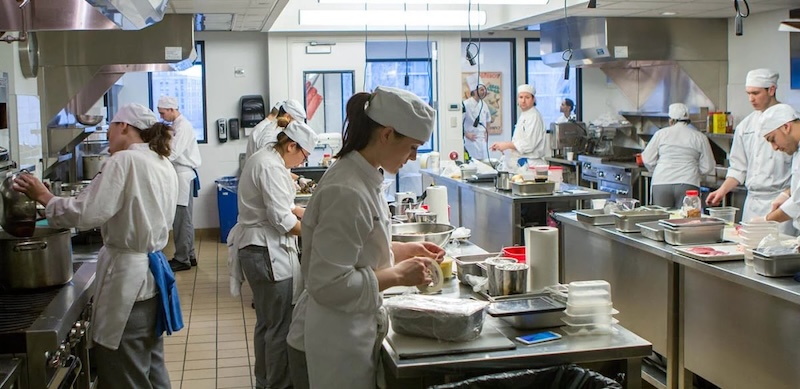
Tip #4: Remind Yourself of How You Like To Be Led (and Act Accordingly)
Great chefs demand high standards, but how they communicate those standards matters.
Instead of reacting emotionally, strong leaders:
- Define and communicate expectations
- Focus on solutions
- Give clear and direct feedback
- Seek clarity with precise questions
- Encourage team members with optimism and receptivity
In a fast-paced environment, energy is precious. Wasting it on anger or ego only makes the job harder.
Tip #5: Look Through a Different Lens
In the moment, a bad service can feel like everything is falling apart. But while most mistakes are temporary, bad behavior — especially from a leader — is rarely forgotten.
When you feel like going absolutely mental, remind yourself of the stakes and force yourself to view circumstances through a different lens. (That’s easier said than done, of course, but it is absolutely vital for chefs hoping to work and thrive long-term.)
Because ultimately, the work we do in restaurant kitchens is important, but it’s not saving lives.
The Last Word
While kitchens will always be demanding, they do not have to be destructive.
A little less “Bear” and a little more Sydney — i.e. patience, respect and accountability — can go a long way toward keeping you and your chef colleagues fit, focused and fulfilled.

More by Rachel Akpotu O'Neill & Amanda Cargill