
Redeploy Your Skills: From Military Service to Professional Chef

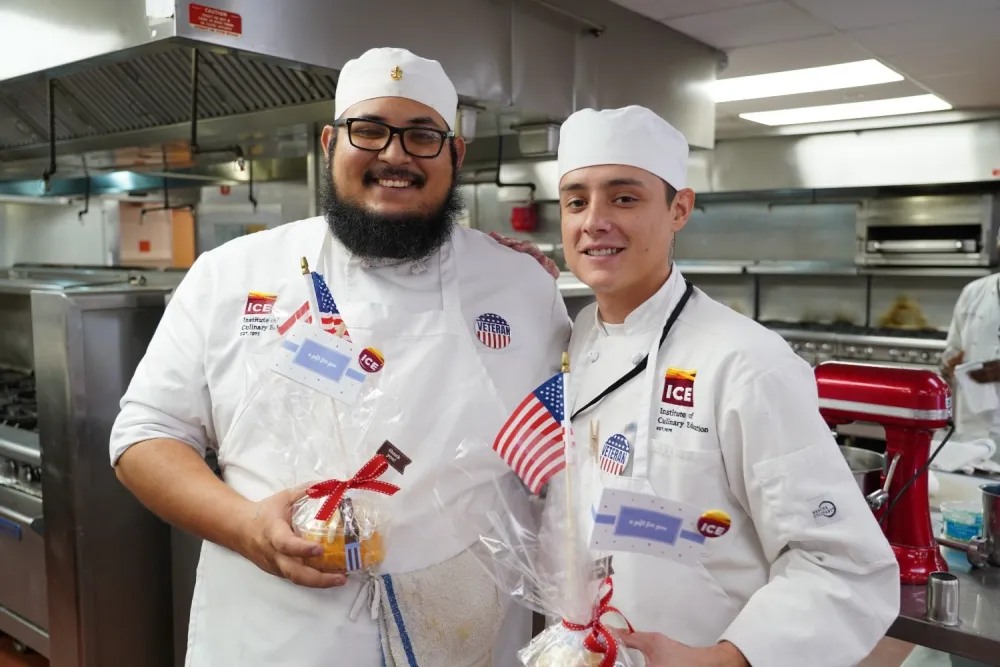
Working as a restaurant chef requires teamwork, discipline and a cool head under pressure. It also requires spending hours on your feet. All of these conditions likely sound familiar to service members.
In the same way that general and sergeant are titles earned over time, "chef" isn't bestowed upon culinary students at graduation. Rather, the skills required to command this title and lead a kitchen are acquired over the course of one's professional career.
Still, military veterans are often uniquely positioned to excel in the culinary and hospitality industries. That's because the work environments, team cultures and organizational structures of the military closely mirror those of professional kitchens.
Just as recruits complete basic training as an introduction to the military, aspiring hospitality professionals can enroll in accelerated career-training programs, like those at ICE, to fast-track their path into the restaurant industry.
This Veteran Became An ICE Chef-Instructor
According to Online Culinary Arts & Food Operations Lead Chef-Instructor Shawn Matijevich, who spent five years as a chef in the Navy, the parallels between the military and professional kitchens can provide comfort to veterans navigating career decisions post-service.
“A lot of what makes you effective in the military already translates directly to culinary work. You don’t need to reinvent yourself,” he says.
“Many veterans take for granted a lot of the skills that they have, that not everybody is always showing up on time in a really nice, clean uniform, with a great attitude," says Chef Shawn. He acknowledges, of course, that not all military veterans or professional chefs are the same, but notes that generally speaking, culinary employers "love veterans because they're ready to go."
Here's how those parallels play out — and how veterans can leverage their existing skills in pursuit of a culinary career.
From Physical Endurance to Kitchen Stamina
Veterans who are used to long hours on their feet in demanding environments may find the pace of kitchen work familiar.
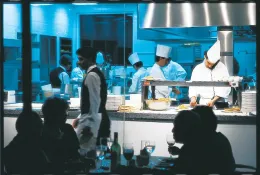
A chef’s job is physical. The work typically involves standing for long shifts, lifting heavy ingredients and working with commercial-grade equipment.
For Chef Shawn, the physicality of restaurant cooking was no surprise. Before he served as executive chef at leading D.C. steakhouse BLT Prime, he cooked for up to a thousand Navy sailors at a time in massive 80-gallon steam-jacketed kettles.
And just as both careers entail a certain level of physicality, they also require a clean, orderly work style.
The kitchen mantra “work clean” likely resonates with veterans who are trained to be prepared, in both their appearance and work habits. A cluttered station, messy uniform or incomplete mise en place (French for “everything in its place,” which refers to prepping tools and ingredients in advance) can lead to a disorganized mind and inconsistent cooking.
The Military Chain of Command Is Similar to the Kitchen Brigade System
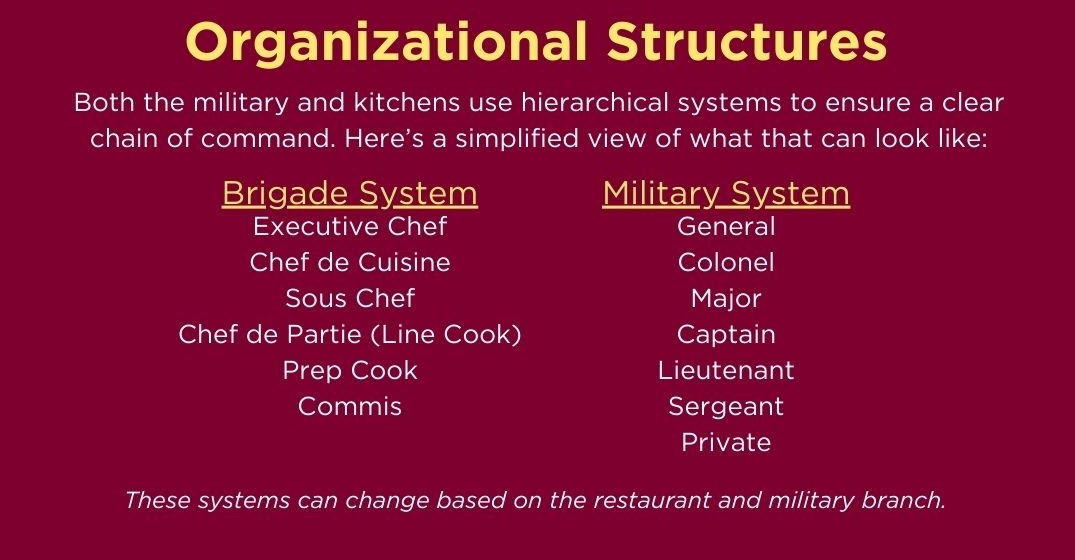
Both the military and professional kitchens are known for their use of clear, structured teams to delineate roles and responsibilities.
The brigade system — which broadly establishes the chain of command in the majority of professional kitchens — was modeled after the French military hierarchy, with the goal of ensuring staff understands who they report to.
Veterans who have experience executing within a structured team may find the brigade system relatable.
This was true for Kenji Alexander Chang, an ICE alum who served in the U.S. Navy. Of his transition from military service to the kitchen, he says, “Being in a structured, hierarchical work environment is when I tend to move the best. I enter a hyper-focused mode with a pinch of OCD; I can get things done.”
Teamwork and accountability play key roles in both work environments. Missions — and meal service — can break down if one part of the team isn’t performing.
“A great kitchen runs like a unit. Everyone has a role, and everyone depends on everyone else,” explains Chef Shawn. “A lot of veterans feel comfortable in kitchens because the culture is direct and team-driven. There’s humor, there’s banter, and feedback is often immediate.”
“Respect is earned through performance, not titles, and that’s a dynamic many veterans appreciate,” he adds.
On the subject of respect, “Yes Chef” and “Yes Sir/Ma’am” are common in both careers and are emblematic of the emphasis each places on effective communication. (The phrase signals to the executive chef or superior officer that you heard and understood the message.)
Staying Calm Under Fire — and During Service
Discipline, efficiency and resilience are just a few of the work habits chefs and soldiers typically exhibit.
Though their stakes are different, both work environments can be high-pressure, requiring effective time management and multitasking skills. As Chef Shawn explains, "The kitchen rewards the same things the military does: discipline, consistency and doing your job at a high level even when you’re tired."
“In the weeds” (restaurant lingo) and “Charlie foxtrot” (military slang) describe chaotic, disorganized situations where things aren’t going according to plan. Veterans accustomed to pushing through physically and mentally demanding situations may find they can keep their cool while cooking on the line.
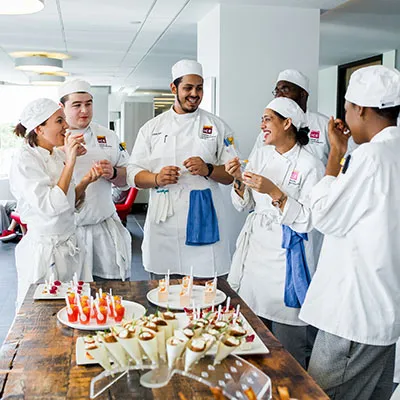
Both military recruits and culinary students practice working under pressure to improve speed and adaptability before entering the real world. (Watch the video below to get a glimpse of this in an ICE restaurant simulation.)
Air Force veteran and ICE graduate Alex Clark recognized how his military skills laddered up to kitchen service. “The skills I learned in the military transfer over to the cooking industry seamlessly: being able to multitask, to move quickly but accurately, most of all serving others, being a part of something bigger than yourself,” he says.
Veterans stepping out of their uniforms may be unsure of what comes next. But a restaurant kitchen — wherein structure, discipline and teamwork are prolific, if not ubiquitous — can make donning chef whites a little more familiar. With the right training and guidance, the skills developed in service could turn into assets in the kitchen.
Military & Veterans who are interested in a culinary education can request more information here.
* Experience varies by student, with outcomes contingent on factors including graduate aptitude, job market, place of residence and work history, among others.