
What Can Students Learn In Online Culinary School? Short Answer: Pro Cooking Skills

Professional cooking is a hands-on craft — built on technique, repetition and real kitchen experience. So how does that translate to a remote environment — where you’re the only person in your kitchen?
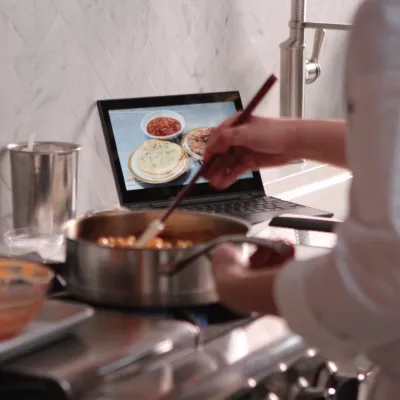
It’s easy to imagine online culinary school as a solitary experience — a lone student in a home kitchen watching cooking videos with little guidance or structure.
However, today’s online culinary programs are designed to mirror many elements of in-person education, combining comprehensive curricula, practical assignments, chef feedback and real-world industry experience.
Together, these components provide the framework to develop culinary skills and habits that prepare students to work in a professional kitchen.
Comprehensive Culinary Training
Watching YouTube videos teaches piecemeal lessons — useful in the moment but rarely designed to ladder up to a larger understanding of cooking fundamentals.
Online culinary education takes a different approach, providing structured curricula to prepare students for the professional kitchen.
These programs explore palate training alongside the theory and science of culinary and pastry arts. Students practice foundational techniques while working with a wide range of ingredients to study global cuisines.
At ICE, the school’s award-winning curriculum taught on campus was the basis for the online programs, which include:
- Culinary Arts & Food Operations
- Health-Centered Culinary Arts & Food Operations
- Baking and Pastry Arts & Food Operations
ICE’s online pastry program, for example, puts a strong emphasis on theory. “Our curriculum starts with cakes, custards and classic European pastries,” says Director of Pastry Research & Development Jürgen David. “The bread portion of the curriculum includes yeast-based classics like bagels, sourdough, pizza and baguettes.”
In some online courses, including those at ICE, students also study restaurant management. Understanding business fundamentals like costing, menu development, kitchen organization and operational strategy can prepare students to lead teams or open their own businesses, which is especially helpful if the goal is front-of-house work or entrepreneurship (like opening your own restaurant or launching a consumer packaged good).
Another advantage of formal training is its scope. Learning to cook or bake to professional standards — using industry practices and mastering multiple techniques and ingredients — can be difficult to accomplish independently. Preparing food in a restaurant is different from home cooking, and structured programs help guide students through a professional lens.
For aspiring culinary professionals who can’t relocate to attend school, online courses can provide the knowledge to launch a career.
Related Read: What Is Online Culinary School Really Like? Get an Inside Look from Real Graduates
Hands-On Labs Help Build Consistency
As with our in-person classes, repetition is an instructional tool used to help build technical confidence for online students.
At ICE, Chef-Instructors lead live lectures that students can attend in real time — bringing the classroom experience into the online environment. (For students unable to watch at a specific time, lectures are available on demand.) Instructional videos and assigned readings round out each week’s lessons, providing additional context to support the culinary, pastry or management focus.
Courses center on hands-on labs wherein students prepare dishes (like Basmati Pilau with Crispy Fried onions and Moti Matal Shrimp*) while practicing techniques ranging from braising to plating. Techniques are introduced, repeated and reinforced, with Chef-Instructors providing feedback on flavor, appearance and cooking processes.
“The knowledge I gained through these courses — through the lectures, labs, readings and discussions — are immeasurable in value to me. It's an experience I will never forget!” said ICE online graduate Jericho Chun-Lai.
As with in-person education, this emphasis on foundational techniques and repetition is designed to develop muscle memory and confidence.
Documenting the Cooking Process
Cooking at home in a formal training program is a multi-sensory experience.
For example, students might grill scallops as part of a lab assignment. They may be asked to write about the food’s flavor profile and texture while also submitting a video documenting the cooking process. Exercises like these encourage students to think critically about flavor development and how to articulate sensory experiences — skills that can translate to menu design, cookbook writing and other culinary careers.
Students also photograph their finished dishes. This is another part of the online experience that's both unique to remote learning and relevant to scores of food media jobs. Food influencers, cookbook authors, restaurant reviewers and recipe editors, among others, all benefit from knowing how to take good food photos. This part of the training can also sharpen plating skills even when presentation isn’t the primary focus.
This layered approach helps students engage more deeply with each lesson. They’re not just executing a recipe; they’re building valuable 360-degree insights to professional-level cooking.
Expert Feedback Helps Reinforce Technique
Perhaps most importantly, students receive personalized feedback multiple times a week.
Skyler Bouchard, who audited ICE’s online program, said: “I know it seems kind of crazy that you’re submitting a culinary assignment to a chef who can’t taste it, but the school has a really good system in place for grading submissions.” (Listen to Bouchard recap her experience taking classes at ICE in the video below.)
Assignments include documentation of kitchen setup, mise en place, cooking process and final presentation. Chef-Instructors review not just the end product, but the videos, photos and written submissions detailing the workflow behind the dish.
Lead Online Chef-Instructor Shawn Matijevich explains, “Each week students bake at home during a pastry and baking lab. This is where they apply what they learned from readings, videos and chef-led lectures. Students document their experience by making notes and taking photos and videos throughout the process. Then, Chef-Instructors review students’ work and provide personalized feedback each week.”
This level of critique mirrors the kind of feedback cooks receive in professional kitchens — and allows students to refine habits early.
The Intangibles Matter
Technical skills are a big part of professional cooking — but they aren’t the whole story. Employers also look for discipline, organization and clear communication when hiring.
Online students practice many of these throughout their training:
- Discipline: Online culinary students manage their own schedules to meet assignment deadlines.
- Working clean: As students document and review their cooking processes, they are encouraged to maintain an organized station — a habit professional kitchens rely on.
- Strong communication: Written reflections and video feedback help students practice clear, thoughtful communication.
- Time management: Balancing coursework with other responsibilities, whether that’s a job, family or career transition, helps students develop strong time-management skills.
These traits mirror those found in professional kitchens, where organization, accountability and clear communication are key.
In many ways, the online format helps prepare students for the actualities of the restaurant industry — the self-motivation and discipline that most successful chefs embody.
Transitioning to the Workplace
At ICE, online programs culminate in an externship. Here, students apply the skills they did (or didn’t) develop in class in a real-world setting — a professional kitchen, bakery or other culinary business. (ICE students work with a dedicated Career Services Advisor who provides guidance on finding and securing an externship.)
This transitional step from online classroom to hands-on, cooperative work environment is critical. It’s designed to reinforce team communication and timing under pressure while students experience the rhythm of restaurant kitchens. Externships are a great time to focus on building industry connections — and can even lead to job offers or continued mentorship.
For students outside major culinary hubs, the externship offers a practical entry point into their local food communities. Rather than relocating for school, they begin building professional relationships where they live.
“I’ve had nothing but great experiences with students from ICE,” says Chef Marcus Samuelsson, reflecting on the students who have externed at his restaurants. “They are eager… and on top of that, great training.”
Many highly acclaimed chefs, who recognize the quality of an ICE education, hire student externs — listen to more testimonials from culinary leaders in the video below.
No culinary program — online or on campus — instantly turns graduates into executive chefs. Just as you don’t graduate from business school and become a C.E.O., a culinary education is a foundation. Even the industry’s most decorated chefs continue learning throughout their careers.
However, what an online culinary education can provide is structure, technical grounding and real-world exposure — along with the habits and mindset that support success in professional kitchens. And for aspiring chefs who can’t attend in person, that foundation no longer requires relocation.
*Curriculum, ingredients and recipes are examples and are subject to change at any time without notice.