
What Is Online Culinary School Really Like? Get an Inside Look from Real Graduates

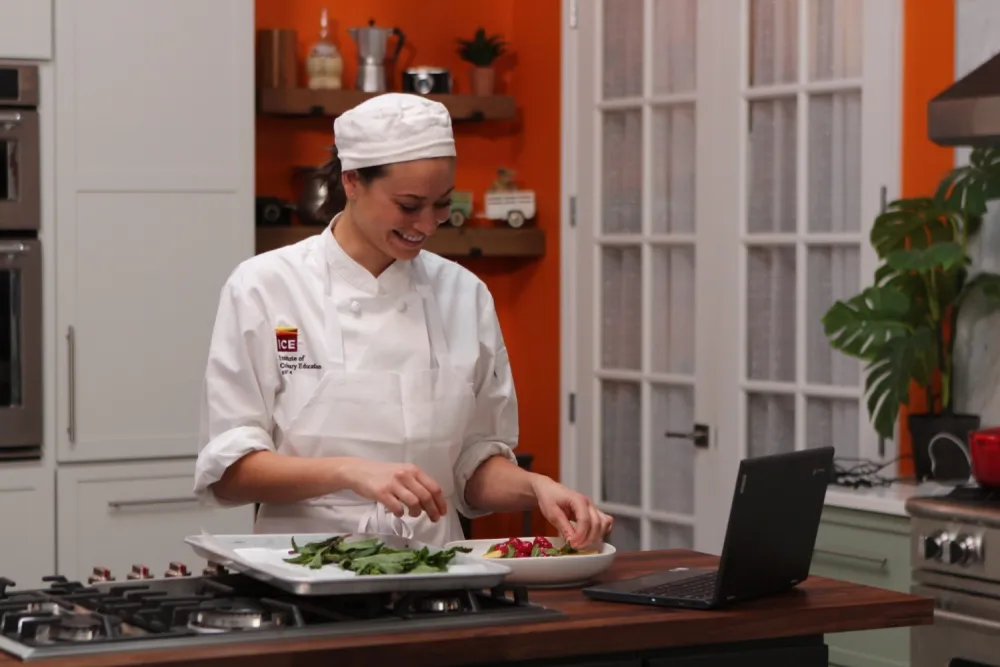
Hearing the experiences of online culinary school graduates is a great way to understand what remote learning is like — and if it’s for you.
For most aspiring hospitality professionals, the dream of attending culinary school comes with a few real-world obstacles. Some can’t relocate to attend in person, and others balance full-time jobs, family responsibilities and financial realities that put in-person and on-site programs out of reach.
At the same time, the demand for skilled culinary professionals continues to grow — from restaurants and catering companies to food media, product development and entrepreneurship, there are countless career paths for culinary school graduates.
This is perhaps why online education is rapidly expanding — Statista* estimates that the number of online education users in the U.S. will reach 87.6 million by 2029 (or nearly one in every four Americans) — and culinary training is no exception.
That’s where online culinary school comes in. ICE’s core career-training programs are offered fully online, bringing the school’s award-winning education into students’ own kitchens.
These programs include:
- Culinary Arts & Food Operations
- Health-Centered Culinary Arts & Food Operations
- Baking and Pastry Arts & Food Operations
- Restaurant & Culinary Management
- Tourism, Travel & Hospitality Management
So, what is it really like to attend online culinary school? And perhaps more importantly, what can you learn in online culinary school?
We asked three recent ICE Culinary Arts & Food Operations graduates to share their experiences and what helped them succeed.
Take Advantage of Flexible Scheduling
The online culinary program at ICE consists of weekly virtual classes comprising chef-led instruction, readings, videos and hands-on labs.
Classes are taught asynchronously, meaning you are not required to log in at a specified time, and students can attend live sessions or study on their own schedule — making it possible to fit school into an already busy life.
For Edward Arguello, this flexibility was a deciding factor. “The program gives you a lot of flexibility if you have a tight schedule, and that was one of the reasons I picked the online program, because I had two jobs and on top of that I also had a family to support financially,” he said.
The average weekly time commitment is approximately 13 hours, which Arguello said is “enough time to finish the assignments each week.”
Over the course of the program, students explore foundational culinary techniques, global cuisines, food service operation, and hospitality management training — to prepare for both the creative and commercial sides of the industry — all from the comfort of their own kitchen.
Remember: You’re There To Learn
Some students, whether attending on-campus or online, may have strong home-cooking skills. (No prior experience is required to attend ICE. The student body includes high school and college graduates, veterans and career changers whose experiences and skills vary widely.)
But ICE graduates say one of the most important shifts when beginning online education is to embrace the student mindset, which is one focused on growth, not perfection.
“I had always considered myself a great home cook but the various assignments and techniques I learned [at ICE] humbled me very quickly,” shared online graduate Eduard Yegishyan. “As a result, I wondered if the professional culinary path was truly for me.”
His number one piece of advice? “Keep at it and don’t stress too much over a few missed points. We are students for a reason, and that reason is to learn and improve.”
Studying online doesn’t mean you’re alone. ICE students have multiple touchpoints with Chef-Instructors each week, and they receive personalized feedback to help refine skills.
Related reading: How to Choose the Best Culinary School for You
Be Strategic about Grocery Shopping
In many online culinary programs, students select their own ingredients, which underscores lessons about food quality and seasonality.
For example, both online and in-person ICE Culinary Arts students study fish fabrication and what to look for when purchasing fish — but only remote students put this into practice during the program.
“There is a lot of fun in this program going to the store and picking your own produce, meats and other ingredients,” Arguello explained, “…it teaches you how to buy fresh and good quality for the labs that you have to do.”
Planning ahead and managing inventory mirrors the responsibilities of professional chefs, and an online education provides students with opportunities to practice these skills at home.
Get to Know Classmates
Even though students aren’t in a traditional classroom setting, the online format fosters strong relationships.
At ICE, discussion boards, group chats and shared experiences help create a sense of community amongst classmates.
“Get to know your cohort if you can… it makes the experience more fun!” said ICE graduate Meriel Evangelista. (Cohort is the term ICE uses to describe a group of students in a specific class.)
“Around the third week or so, [my class] all decided to exchange numbers and have been in constant contact ever since. It’s so helpful to be able to bounce ideas off each other or ask quick questions,” added Evangelista.
Building relationships amongst classmates and Chef-Instructors sets the foundation for a culinary network that can provide career support, mentorship and job opportunities.
Sidebar: ICE students also benefit from an alumni network of over 20,000 graduates whose careers span the hospitality and culinary industries. Examples include Gail Simmons (Top Chef judge and producer), Mashama Bailey (James Beard Award-winning Chef / Restaurateur), and Kerry Brodie (CNN Hero and Founder of Emma’s Torch).*
Discipline Makes the Difference
Like any school, online culinary education requires commitment. Although remote learning offers enhanced flexibility, students who treat the program like a professional responsibility — showing up consistently, staying focused and managing their time — tend to get the most out of the experience.
“Make the most of it,” said Evangelista. “You’re likely doing an online program because you can’t attend culinary school in person, there are no schools near you, it’s within your budget, or you need flexibility because you have a full-time job. Just because it’s not in person does not mean you shouldn’t give it your complete time and attention.”
Check out the video below for more insights and success stories from graduates of ICE's online courses.
Online culinary school allows aspiring culinary professionals to build resume-worthy skills without putting their lives on hold — no matter where they live.
ICE Culinary Arts & Food Operations students can earn a diploma or an Associate of Occupational Studies degree**. Request information about the different options here.
*Statista, 2025
**Students in a growing number of states can now enroll in online education, find more information here.
*Experience varies by student, with outcomes contingent on factors including graduate aptitude, job market, place of residence and work history, among others.