
Formal Restaurant Business Training vs. Learning “On the Job” — What You Need To Know


Why do restaurants fail? Is it the high cost of sales, expensive labor or rising occupancy cost? Is it location, value perception or overall experience? The answer can be hard to pin down.
That’s because, while many people have expertise in cooking, baking and pastry — they acquired these skills in school or on the job — most of them didn’t train in running a business (and what they need to know before launching it).
Is 360° food business training possible?
The unfortunate news is that once you’ve started working in the industry, there’s rarely someone willing or able to train you in all the aspects of business operations.
Rather, those who learn “on the job” tend to acquire knowledge in a single area of business — for example, becoming a better cook or learning to run the restaurant’s front of house — and then grow and strengthen that knowledge within a silo.
Does this mean that you can’t learn operations and build strong management skills while you’re already in business? No… but it’s rare.
The data supports the hypothesis
I’d be surprised if more than 20% of the industry understands how to efficiently operate a venue (which may explain why close to 80% of businesses fail within three years of opening).
In my 20-year career, I’ve opened, operated, managed, licensed and consulted on over 30 Food & Beverage businesses. I also teach Restaurant & Culinary Management at the Institute, where I was a prior dean. As such, I’m often asked by students, clients and restaurateurs formal restaurant and culinary management training is worth taking.
My response is a definitive “yes.” In my experience, the program’s value is its totality, and the fact that many of the skills it teaches and the expertise it imparts can’t be learned on the job.
These skills and expert insights equip graduates with the tools to make better business decisions – and better business decisions increase the likelihood of success.
What does a restaurant and culinary management program cover?
BUSINESS PLANS
Defining your concept, menu and brand, as well as the “why” behind your business is key. Business plans cover a lot of territory. Examples include: target audience, marketing strategy and staffing, as well as:
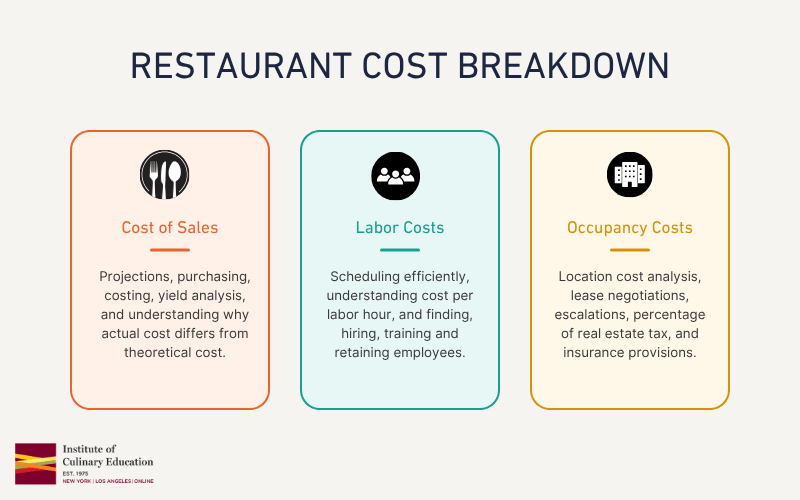
- Projections – mapping out your F&B expenses, your ratio of food to beverage, your projected food & beverage sales and your other fixed and variable expenses Typically, these are included in your business plan.
- Capital Budget – determining the total cost of opening your venue, including working capital (i.e. the extra funds available for “a rainy day.”) How much funding do you need? This is also typically included in your business plan.
Operating Agreement
Before opening, understanding and negotiating this document is critical. Key considerations include:
- Voting (e.g., Who gets a vote on business decisions? Is there tiered voting? Are voting results majority, unanimous or executed by a manager?)
- Who are the voting members, what are their rights, and what is the process for adding and removing them?
- How and when do members receive profits?
- Who has right of first refusal (if any) on new projects?
- Who owns the intellectual property?
LOCATION & LEASING
Selecting and conducting a location cost analysis is vital to long-term success.
- Can you afford your preferred location?
- How do you calculate its affordability?
Also important: negotiating the length of your lease, option years (if any), escalations, percentage of real estate tax paid and insurance provisions and various contingencies.
MARKETING
Think about how you’ll get the word out about your business.
- What combination of internal, external and/or community marketing do you choose?
- Should you hire public relations?
- Do you outsource your social media management?
- How do you stay “on brand”?
- How do you determine demographics, psychographics and geographics?
- How do you correctly set up and optimize your website?

STAFFING
This includes determining your organizational structure then finding, interviewing, hiring, onboarding and retaining employees.
- Management
- What salaried employees are needed for your venue?
- How much can you afford to spend on management?
- What roles need to be filled for your entity?
- How do you train managers?
- Recruitment
- How do I hire well?
- What questions should I ask in an interview?
- Do I understand HR and what can and cannot be asked during an interview?
- Do I know what technology and websites to use?
- Training
- How to train employees (pre-opening and ongoing)?
- How do we determine if an employee is ready to be a manager?
- What skills make a great manager?
- Can leadership be trained?
DOLLARS & CENTS
- Labor
- Do I understand scheduling?
- Am I scheduling effectively / efficiently?
- Do I know what my cost per labor hour is?
- Purchasing – understanding the full product lifecycle from ordering to plating
- Costing
- How do I cost out a menu?
- Am I using technology?
- Do I understand yield?
- Why is my actual cost different from my theoretical cost?
- What went wrong and how quickly can I find out what the issue
- Financial Reporting – understanding how to read a P&L
- What are my financial goals?
- Do I analyze weekly reporting?
- What are my Key Performance Indicators KPIs)?
- What is prime cost?
Systems and Standards
It’s important to have everything that you’ll need to run your establishment documented before you open. This includes your Employee Handbook, service manuals, recipes and costing, opening and closing work, side work (what to do when there’s nothing to do) and many more Standard Operating Procedures (SOPs).
Technology
Ask yourself the following questions:
- Am I aware of the ever-changing landscape of available technology?
- What aspects of my business should I use software / services for (recipe costing, purchasing, inventory, payroll, scheduling, point of sale, reservations, etc)?
- Does my tech stack need to be integrated?
- How do I decide what will work best for my operation?
These are just some of the areas that aspiring operators must understand prior to launching their food & beverage business. All of the above, and more, is covered in our Culinary Management program.