
Restaurant Tech 101: These are the Tools Managers and Owners Swear By

Across my 20-year career opening, operating and consulting on more than 30 food and beverage concepts in the U.S. and abroad, the tools used to power the industry have changed dramatically.
For example, when I opened the restaurant 5 Ninth in 2004, our tech stack fit on a few Micros terminals and a reservations book. There were no reservation apps — we knew our regulars because our maître d' and servers remembered them — and we had no real-time insights to food and beverage costs (because this capability didn’t yet exist).
Today, a smart tech stack can yield accurate information at lightning speed, enabling operators to better manage inventory, labor, reservations, marketing and guest data. That said, more tools don't always yield more efficiency, and not every piece of technology is worth the investment.
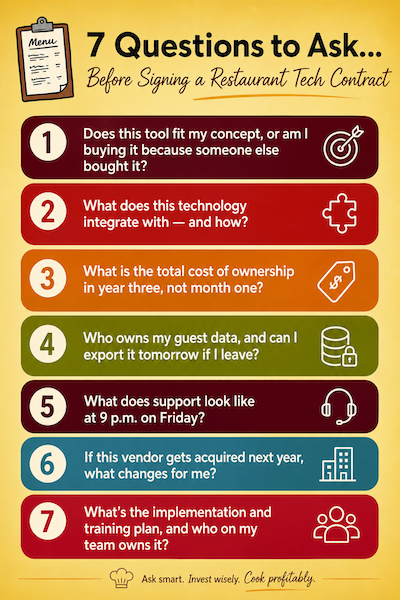
What follows are the seven categories that comprise a cohesive restaurant tech stack; an explanation of what each does; and tips for what you should ask before you sign anything.
1. Point of Sale: The Backbone of the Entire Operation
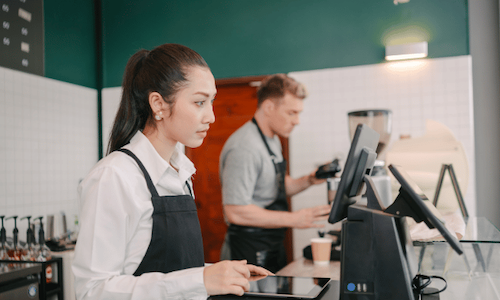
Every transaction flows through the POS. Treated well, that data becomes the spine of menu engineering, labor productivity, cash control, and the financials you'll hand an investor or acquirer.
Top operators don't think of their POS as a cash register. They think of it as the data backbone that every other system depends on.
Stack integration starting at the POS is one of the topics I cover with my Culinary Management Diploma students at the Institute. It's where many restaurants lose money without realizing it.
If your POS system — with industry leaders including Toast, Oracle Micros, Aloha, Lightspeed, SpotOn and Square — can't cleanly feed your inventory, accounting and CRM, your business software will leak time and money every week. A customer relationship management system, or CRM, tracks client interactions to help build lasting customer relationships.
2. Reservations Platforms Became Revenue Platforms
Booking a table is the least important thing this category does. Great restaurants use it to manage pacing; sell prepaid experiences; run premium-reservation pricing on the most desirable times; and surface VIP notes, allergies and table preferences the moment a guest walks in.
our reservation platform is now also your revenue management system. Because it is increasingly the gatekeeper to guest data, recent ownership shifts raise a question every operator should ask: “Who owns my data?” American Express now owns both Resy and Tock, and DoorDash recently bought SevenRooms. Along with OpenTable, these are the names that matter in the category.
3. Operations Software Is Where Restaurants Win or Lose Money
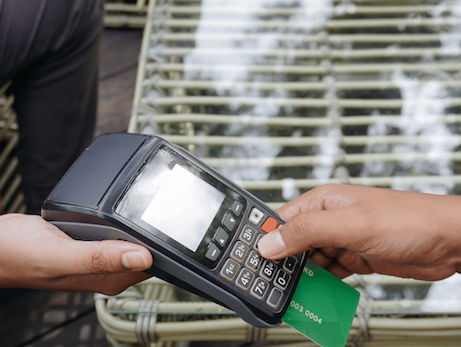
In many casual-fine restaurants, labor and food costs can consume 55 to 65 cents of every revenue dollar — and even more in fine dining. This is still where restaurant technology delivers the highest ROI.
AI-powered scheduling tools use factors like weather, daypart traffic and event calendars to better predict staffing needs. Restaurants using these systems report labor-cost reductions of 8 to 12 percent.
For a $3 million restaurant where labor accounts for roughly 20 to 30 percent of revenue, a 12 percent reduction in labor costs could translate to more than $100,000 in annual savings.
Invoice-scanning and recipe-costing software can also flag food-cost issues in real time instead of weeks later. Restaurants that get this right can close the gap between theoretical and actual food costs while there’s still time to correct the problem.
4. Kitchen Display Systems (KDS) Keep Service Moving
The KDS is the conductor of the back of house. It routes tickets by station, sequences courses, tracks ticket times, and gives the chef real-time visibility into kitchen flow. Great fine-dining kitchens use it to hit course-coordination and ticket-time targets that paper tickets simply cannot keep up with. KDS is usually an option with the POS.
5. CRM, Loyalty, and Marketing: Recognition at Scale
Knowing your guests has always been the job. Tech makes it possible to remember 30,000 guests the way the maître d' once remembered 300: allergies, anniversaries, table preferences, the last bottle they ordered. Union Square Hospitality Group calls this "reading and feeding signs." Will Guidara built a book around it (Unreasonable Hospitality).
The same program also drives direct-to-guest marketing and ordering, which is how successful restaurants reduce their dependence on third-party aggregators.
On CRM and guest data, SevenRooms leads the upper tier, with Thanx and Bikky rounding out the established category. Olo, Popmenu, Owner.com provide marketing and first-party ordering solutions for independents. Blackbird, founded by Resy co-founder Ben Leventhal, is the newer loyalty-and-payments entrant gaining traction with independent fine-dining operators thanks to lower processing fees (around 2 percent versus 3.5 percent) and direct guest data ownership.
6. Business Intelligence Turns Gut Feel into Strategy
Great operators have strong instincts. Exceptional operators verify those instincts with data. BI tells you what actually paid off: which servers genuinely upsell, which menu items are theoretical-versus-actual food cost outliers, which nights are quietly bleeding labor hours. Restaurant365 and Avero are the leaders here.
7. Accounting and Financial: Clean Numbers Win
This is the layer your accountant, your banker, and potential investors or buyers will scrutinize. The operators I see succeed run weekly P&Ls, daily POS-to-bank reconciliations, and a clean chart of accounts. They know their prime costs before the month closes. QuickBooks is nearly universal here. Restaurant365 integrates the financial and operational stacks in one place.
Too Much Tech, Not Enough Hospitality
Over the years, I've watched smart restaurateurs make four very specific mistakes with tech.
- Shiny object syndrome: buying the tool a 14-unit group uses because it sounded smart in Eater.
- Tech replacing hospitality instead of amplifying it: QR-code ordering belongs in fast-casual, not at a $200 tasting menu where service itself is part of the experience.
- Stack bloat: twelve vendors, twelve logins, no real integration.
- Cybersecurity neglect: should be impossible to ignore.
The best restaurants use technology to create more time for human work that keeps guests coming back. To learn more about building a tech stack that supports — rather than replaces — hospitality, explore the Culinary Management Diploma program at the Institute of Culinary Education.