
Michelin Stars, Ajitama Tacos, and a New Restaurant Culture: Meet Chef Sam Clonts


To celebrate 50 years of ICE, we’re honoring 50 distinguished alumni. Meet Chef Sam Clonts, the Michelin-starred chef behind Sixty Three Clinton and Cactus Wren in New York City. A graduate of ICE’s Culinary Arts program, Clonts trained at the three‑Michelin‑starred Chef’s Table at Brooklyn Fare for more than five years before becoming Executive Chef at Bar Uchū, where he earned his first Michelin star at just 26. Since opening Sixty Three Clinton in 2021 with long-time partner Raymond Trinh, his approachable tasting menus and team-first ethos have rewritten the rules of fine dining.
Chef Sam Clonts began his culinary career the way many great chefs do: behind the dish pit.
Before that, he was in Tucson, Arizona, cooking alongside his mother and learning the rhythms of the kitchen at home. It wasn’t until high school, when he looked into enrolling in a culinary arts program, that he considered cooking as a career.
His first job, washing dishes at a local restaurant, gave him a front-row view of professional kitchen operations. Watching the line, listening to the calls, and cleaning every station taught him the pace and discipline of the industry long before he stepped onto the line himself.
That early exposure laid the foundation for a rapid rise. Chef Sam was soon running stations at The Ritz-Carlton Dove Mountain. (He was still a teenager.)
Determined to test himself in a larger market, he decided to enroll at the Institute of Culinary Education and moved to New York to pursue a Culinary Arts diploma. While completing the program, he worked at The Ritz-Carlton Battery Park and was placed in an externship at Chef’s Table at Brooklyn Fare, one of a select few New York City restaurants with three Michelin stars.
Known for its 18-seat counter and rigorous, seasonally driven tasting menu, Chef’s Table set a new standard for Chef Sam. He remained there for more than five years, working across every station and internalizing the focus and refinement required to chef in one of the country’s most exacting kitchens.
In 2017, Chef Sam stepped into the spotlight when he accepted the role of Executive Chef at Bar Uchū, a modern kaiseki-style restaurant on Manhattan’s Lower East Side. That same year, he earned his first Michelin star, becoming one of the youngest American chefs to receive the honor. Bar Uchū featured two counters, one for sushi and one for kaiseki, with Clonts leading the latter.
Chef Sam’s next venture was more personal — and even more ambitious. In 2021, he and longtime business partner Raymond Trinh opened Sixty Three Clinton, a 40-seat tasting-menu restaurant just a few blocks from Bar Uchū. The menu blended global techniques and nostalgic Americana, drawing on a combination of Chef Sam’s fine dining training and his childhood memories.
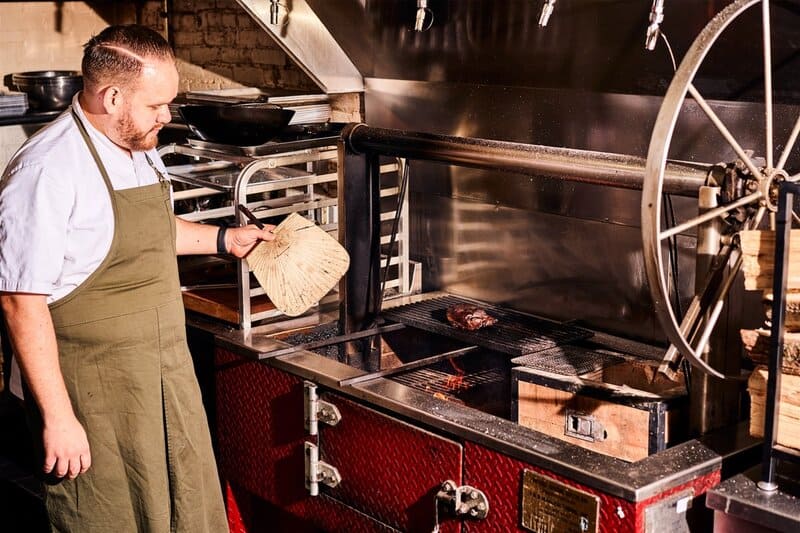
It quickly garnered critical praise — Eater described it as a “fine dining restaurant dressed up in cool clothes,” and highlighted its signature caviar hand roll and breakfast taco made with ajitama egg, salsa verde, and trout roe — and it received a Michelin star within its first year of business.
But accolades weren’t the only success metric. One of Chef Sam’s proudest achievements at Sixty Three Clinton was offering full healthcare benefits to the entire staff, a rare and meaningful commitment in the independent restaurant world.
In 2024, Chef Sam launched Cactus Wren, a concept that reconnects him with his Southwestern cooking roots. The restaurant adds to a growing body of work that reflects both his technical precision and his personal history.
Across all of his projects, Chef Sam has continued to mentor young cooks, build collaborative kitchen cultures, and evolve his culinary point of view.
He says ICE set the foundation for this growth, noting that the school provided technical training, exposure to professional standards, and a pathway into the industry, most notably through the externship that launched his time at Chef’s Table.
We asked Chef Sam five key questions about mentorship, creativity, and the realities of running a Michelin-starred kitchen. Here’s what he had to say.
* The following interview has been condensed and edited for clarity.
ICE: What do you consider to be your biggest professional achievement?
Chef Sam: There’s been a few big ones that stick out. One of the biggest was working for over five years at Chef’s Table. Then, there’s becoming an executive chef at 25, and winning a Michelin star the same year.
Another achievement I treasure is opening my own restaurant, Sixty Three Clinton, with my long-term business partner, Raymond Trinh — and then winning a Michelin star there.
One of the most meaningful milestones was offering full healthcare to our entire staff. That one felt particularly rewarding — to be able to provide that benefit as a restaurant owner felt like a big accomplishment.
And, of course, the opening of Cactus Wren.
ICE: Can you describe your creative process?
Chef Sam: It can take many forms. Sometimes, I can be inspired by a dish I see or eat while traveling. Sometimes, it’s seeing what’s new in the market. Many times, I’ll be inspired by the sous chefs and cooks that I work with, either by encouraging their menu input or even the family meals they make.
ICE: What would you say to people looking to follow a career path similar to yours?
Chef Sam: I think it’s important to find a good kitchen that you can spend several years growing in and learning all the ins and outs of a restaurant. Not just picking up a couple stations, really learning all the small things that make a restaurant successful.
ICE: When you think ICE culinary, what’s the first word that comes to mind, and why?
Chef Sam: Foundational.
ICE does a good job of giving cooks a great foundation to build off of. You learn what you need to know to start working in a kitchen, and they help you find that kitchen as well. It’s a good start for any cook’s career.
ICE: When did you realize you had a passion for food, and when did that turn into “I want to work in food?”
Chef Sam: Growing up I was always in the kitchen with my mom and family and enjoyed cooking myself. Then in high school I had an amazing culinary program and instructor who made me realize it was something I was good at, and he helped me find my first job as a dishwasher.
QUICKFIRE QUESTIONS
Favorite kitchen tool? Small offset spatula.
Salty or sweet? Salty.
Favorite food holiday? Thanksgiving.
Favorite food city? Paris.
Cook, bake, eat… in order of preference? Cook, eat, bake.
Favorite cuisine? Mexican/Southwest.
Favorite food season? Summer.
* Experience varies by student, with outcomes contingent on factors including graduate aptitude, job market, place of residence and work history, among others.