
At Chef Eric Ripert's Le Bernardin, ICE Alum Orlando Soto Is a Star In His Own Right

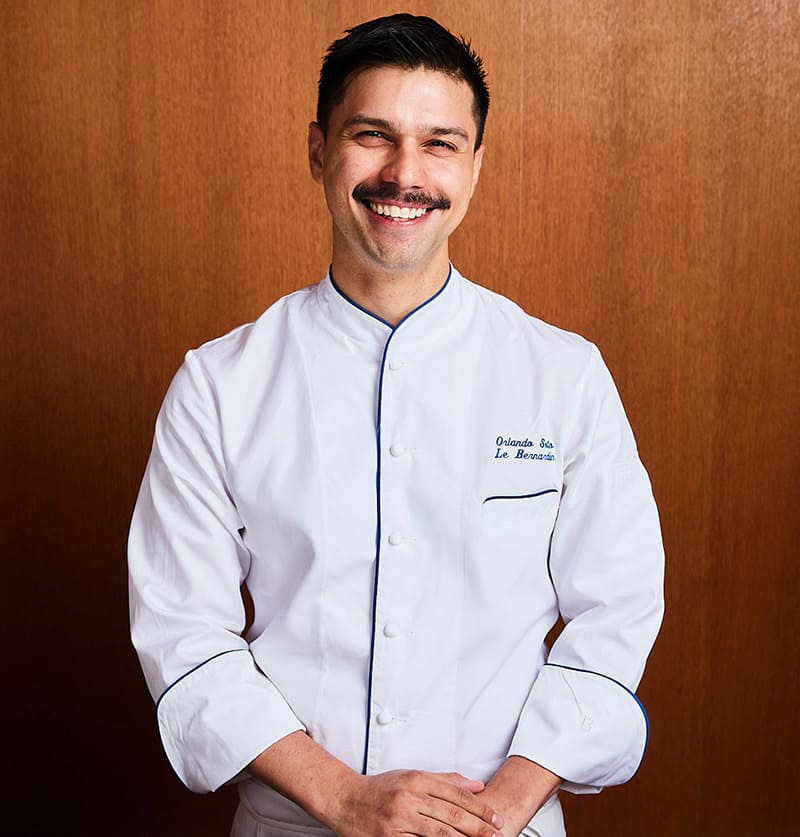
To celebrate 50 years of ICE, we’re honoring 50 distinguished alumni. Meet Orlando Soto, a dual diploma graduate of ICE’s Pastry & Baking Arts and Restaurant & Culinary Management programs and the Executive Pastry Chef at Le Bernardin, Chef Eric Ripert’s three Michelin-starred seafood restaurant.
At Le Bernardin, Chef Orlando has established — and continues to refine — a dessert program rooted in precision, balance and elegance.
But his career didn’t start in pastry. It began in science.
A Fork In the Road
Born and raised in Puerto Rico, Chef Orlando was initially a pre-med student at the University of Puerto Rico–Mayagüez. However, his second year studies turned him on to chemical engineering — the first of two changes to his career plan.
Prior to receiving his engineering degree, Chef Orlando spent two summers interning in the U.S. The work, he explained to Penny De Los Santos on her Depth of Field podcast, was stressful. To manage it, he “started baking at night to bring stuff the next day for his lab mates.”
“It was a fun time to test out things,” he said, noting that he went through a “vegan stint” in college, and thus, baked recipes he’d not tried before.
“The next thing you know,” he explained to De Los Santos, “I’m making ice creams and all these other things and sharing them — and I’m like, ‘Ooh, I’m actually liking this.’”
Back To School
That passion for baking — pastry, in particular — prompted the second change in career plan.
In 2014, he enrolled at the Institute of Culinary Education in New York City to pursue a dual diploma in Pastry & Baking Arts and Restaurant & Culinary Management.
The original plan was to spend one year in the city for his pastry training followed by a return to Puerto Rico. “That was almost ten years ago,” he said.
Doubled Up
His dual-track education equipped him with a combination of culinary fundamentals and operational fluency — a one-two punch that laid the groundwork for managing pastry programs holistically, as both a craftsman and a culinary leader.
While the pastry program immersed him in core techniques like laminated doughs, chocolate work, and plated dessert composition, the management curriculum covered everything from cost control to team leadership.
He got his start working in the production kitchen at Milk Bar, an experience that introduced him to the scale and precision of high-volume service. He followed that with externships and pastry positions at a series of elite New York restaurants, among them Per Se, Daniel, Günter Seeger, and Ilili.
Each kitchen honed a different skill: plated desserts, classical French execution, speed, and consistency. These formative experiences helped shape his meticulous, clean-lined style.
Climbing the Kitchen Ladder
Chef Orlando’s first executive role was at CATCH STEAK, where he dabbled in plant-based desserts, nontraditional ingredients, and allergen-conscious pastry development.
Reflecting on his career progression, he told Culinary Agents, “All of my jobs have impacted my career in different ways. I learned a lot about production volume at my last two jobs, while I took in more about high-level pastry at Per Se and Dinex."
To De Los Santos, he put it this way: “I was very fortunate that I did my externship at Per Se and that opened the door. The chef … there knew so many other pastry chefs in the city — because the pastry circle is really small in [New York] compared to the nation — so next thing I know I’m staging at Daniel Boulud.”
De Los Santos' response is apt: “There’s a theme here: excellence.”
Enter Le Bernardin
In 2022, he was named Executive Pastry Chef at Le Bernardin, a revered three‑Michelin‑starred seafood restaurant. There, Chef Orlando’s scientific precision and curiosity, shaped by his unique combination of engineering and culinary arts education, was fully realized.
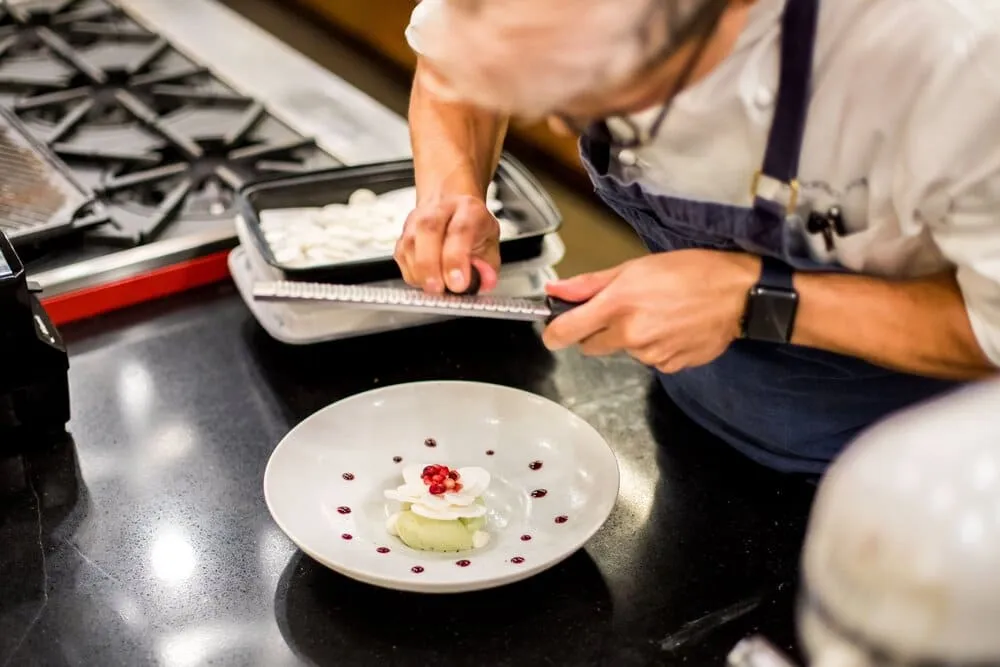
His technical finesse is highlighted in a 2024 Food & Wine piece on the quenelle technique. Here, Chef Orlando uses a Rocher spoon to perform a deliberate sweep of the wrist, producing smooth, symmetrical shapes. The dessert must be properly tempered, he insists — neither too hard nor too soft — so that it holds its form.
He also emphasizes that a quenelle’s visual “proportionality” reflects the refined aesthetic of fine dining.
Technique Plus a Personal Touch
A thoughtful personal touch is a thread that runs throughout Chef Orlando’s dishes. In a 2023 Instagram post featuring a guava-based dessert, he referenced his island roots: “[It’s] a vacherin that hits close to home, combining my favorite fruit growing up in Puerto Rico: Guava, known in Puerto Rico as Guayab,” he wrote.
Chef Orlando's nostalgia and creative passion are present in everything he does. In a speech delivered to ICE graduates at the school's 2023 commencement ceremonies, he said: “When you feel like the odds are against you, or that things are falling apart, remember to keep your head up, remember your power, and turn that feeling into art."
It's a philosophy that captures the emotional core of his craft — and enables him to transform pastry and baking deliciously inventive sculptures on a plate.
An Integrated Training Tool
As ICE marks 50 years of culinary education, celebrated through alumni honors and special programming, Chef Orlando’s career arc — from engineer to executive pastry chef at one of the world’s finest restaurants — reflects the value of ICE’s integrated training model: the Pastry & Baking Arts curriculum for technical skill; the Restaurant & Culinary Management program for leadership readiness.
Reflecting on his career path and the purpose he's found in professional pastry and baking, Chef Soto says, “Every opportunity is like walking into a new classroom, all towards the same goal: to serve, to nourish, to remind others of the singular gift that makes us human — our ability to connect through food. That is our power.”
We'll toast to that, Chef!
* Experience varies by student, with outcomes contingent on factors including graduate aptitude, job market, place of residence and work history, among others.