
The Only Greek Woman To Have Two Michelin Stars Is an ICE Alum: Meet Chef Georgianna Hiliadaki


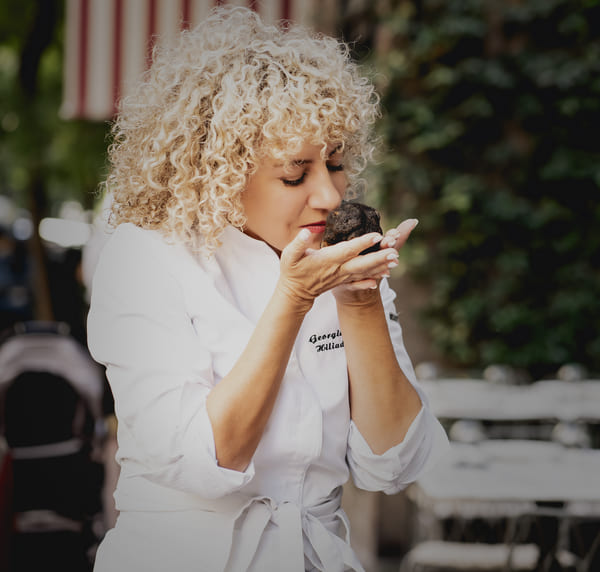
To celebrate 50 years of ICE, we’re honoring 50 distinguished ICE alumni. Meet Chef Georgianna Hiliadaki, the owner of IODIO in Athens and the only Greek woman to win two Michelin stars.
To award-winning Chef Georgianna Hiliadaki, cooking is not just a job.
“It’s my rhythm, my heartbeat, and a source of endless inspiration,” she said in a recent interview with ICE culinary.
As the executive chef and co-owner of IODIO restaurant in Athens, as well as the only Greek woman to have earned two Michelin Stars — they were awarded for her innovative cooking at Funky Gourmet, a pioneering restaurant she ran with chef and fellow ICE alum Nikos Roussos until it closed in 2019 — this philosophy makes sense.
But Chef Georgianna’s successful food career wasn’t a given.
Growing up in Athens, she loved to be in the kitchen, but it wasn’t until she graduated from university that her father encouraged her to attend culinary school in New York City — at the Institute of Culinary Education.
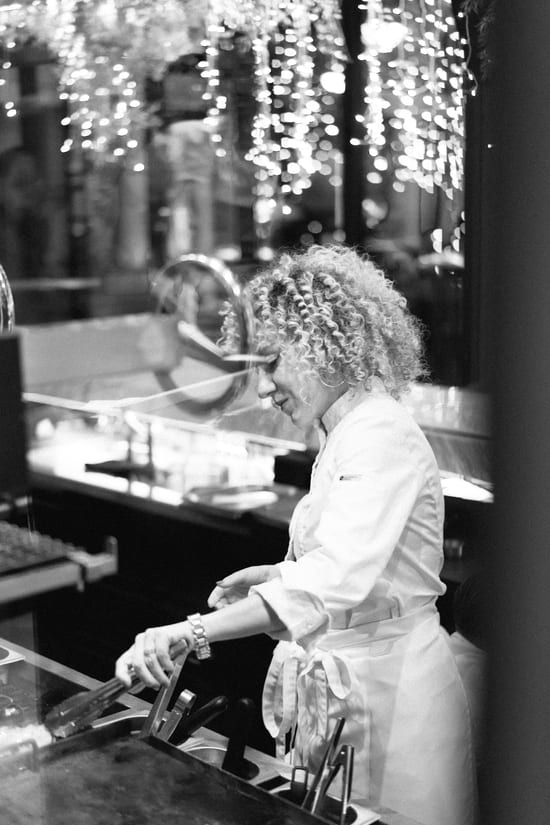
Now, as one of Greece’s most accomplished chefs, she spends her days cooking at IODIO and consulting on projects in Athens and beyond.
We caught up with the busy chef and asked her to tell us about the incredible career she has forged since graduating from ICE’s culinary arts program — and how culinary school set her on the path to success.
* The following interview has been condensed and edited for clarity.
ICE: What do you think is your biggest professional achievement?
Chef Georgianna Hiliadaki: My proudest is definitely earning two Michelin stars with my former team for my restaurant Funky Gourmet. We opened in 2009, and just a few years later, in 2012, we received our first Michelin star. I was 31 at the time. Then in 2014, we were awarded a second Michelin star, which was a huge milestone for us. It was an unforgettable moment, and to this day, I remain the only Greek female chef in the world to have received two Michelin stars.
[Another] highlight … has been the opening of my newest venture, IODIO, a seafood-focused restaurant that launched in the heart of Athens in November 2024. It’s a project [focused on] the beauty of fresh Greek fish, blending tradition with creativity.
ICE: To what factors do you attribute your success so far?
Chef Georgianna: Passion, persistence, hard work, clear goals, and of course, a little bit of luck.
ICE: When did food become something that you wanted to pursue professionally?
Chef Georgianna: I started cooking when I was really young, just by helping my mom in the kitchen. She had such a love for traditional home cooking, even though she was a dentist by trade. I think that’s where it began for me.
ICE: In what ways has the industry changed since you first got into it?
Chef Georgianna: When I first entered the industry, the kitchen was a quite strict place. Fast-paced, intense, and honestly not always the easiest place to be, especially as a woman.
Personally, I consider myself lucky to have opened my own restaurant early on, which gave me the chance to pursue my career without running into many of the challenges and inequalities often talked about in the industry.
But I’ve noticed that things have shifted over the years. A lot more respect is shown now. [There’s more] collaboration and more room for creativity and personality.
I also love how guests have become more curious and engaged. They care about the story behind the food — where it comes from — and are open to new flavors and ideas. Bonding between the personnel of the restaurant and the clients has been the key.
ICE: So you think the industry is headed in the right direction?
Chef Georgianna: I love evolution, and I prefer to carry the industry's best parts forward — and cook with more clarity, intention, and heart than ever before.
ICE: Is there anything that’s unique to fine dining that you can share with future restaurant owners?
Chef Georgianna: The biggest lesson I’ve learned is this: creativity can spark attention, but only soul and discipline build legacy.
At Funky [Gourmet], we challenged everything — we were bold, playful, radical. At IODIO, the creativity is still there, but it’s calmer, deeper, more rooted. It’s about cooking that nourishes, not just impresses. And I’ve realized that true success is not found in how loudly a dish speaks, but in how deeply it’s felt.
The one thing every cook should know about fine dining? It’s not glamorous. It’s not about the spotlight. It’s about showing up with humility, precision, and care — every single day.
The best cooks don’t just chase perfection. They respect the process, the ingredients, the team, the guest. If you can’t clean a station properly, don’t expect to plate caviar. Fine dining is a craft and we should treat it like that.
ICE: What does a typical day look like for you now?
Chef Georgianna: A typical day starts at exactly 7:00 a.m., when my dog Branko gently nudges me awake for early-morning cuddles. I enjoy my first cup of coffee in silence — the only calm moment before the chaos begins.
After school drop-off, around 9:00 a.m., I head to the gym — healthy body, healthy mind! By 10:00 a.m., it’s time for emails and WhatsApp. At 2:00 p.m., I’m [doing the] rounds at the restaurants I consult for — GECO at the Gatsby Hotel, YABOO Bar-Restaurant in Piraeus, and the IASO Group maternity suites. These visits include quality control, meetings, and even quick supplier stops, when needed.
By 4:00 p.m., I return to my base — IODIO. I catch up with my partners, Haris Spyrou and Danae Voridou, and the rest of the team. We go over bookings, inspect ingredients, taste dishes, and refine ideas. At 6:30 p.m., we hold our pre-service briefing with front and back of house, and by 7:00 p.m., the doors open and the restaurant comes alive.
It’s intense, but time flies when you’re in the zone.
By 11:00 p.m., things begin to slow down. Eventually, I head home. I tiptoe into my kids’ rooms, give them a kiss goodnight, and finally go to bed — grateful, fulfilled, and ready to do it all again the next day.
ICE: What would you say to people looking to follow a career path like yours?
Chef Georgianna: Stay passionate and patient. The culinary world is demanding, but if you truly love it, every challenge becomes a lesson. Keep learning, stay curious, and don’t be afraid to take risks or make mistakes. Most importantly, focus on your goal, and let that drive you forward.
ICE: When you think of ICE, what’s the first word that pops into your mind?
Chef Georgianna: Cornerstone. ICE isn’t just a culinary institution. For me, it was where everything started to become real and take shape. It gave me the technical skills, the confidence, and the discipline I needed to turn my passion into a real path.
It was the teachers, the facilities, and Mr. Rick Smilow, the school’s Chairman and Founder truly motivated me to aim high. Their passion, support, and belief in excellence helped me see what was possible — and pushed me to chase it without compromise.
ICE: What did you learn at ICE that helped you at the start of your career?
Chef Georgianna: I learned the fundamentals — not just of technique, but of discipline, precision, and respect for the craft. Those early lessons shaped the way I moved in a kitchen, how I approached ingredients, and how I communicated with a team.
But more than anything, I learned that cooking at a high level isn’t about perfection — it’s about consistency. That mindset helped me build a solid foundation when everything else around me was still new and unknown.
ICE: Did you have specific mentors?
Chef Georgianna: In the beginning, it was my mother who introduced me to the love of cooking and became my very first mentor, always believing in me. My father played a crucial role because he urged me to pursue cooking professionally.
Some mentors were instructors at ICE, like the one and only Chef Ted Siegel; others were professionals I met along the way.
Today, I strive to do the same for others — through the guidance I provide to my team and by creating a space where everybody in the restaurant feels comfortable to develop their talent and personality. I’ve been fortunate to collaborate with many gifted young chefs, several of whom started in Funky Gourmet and are now building their own careers.
ICE: Is there any single lesson that you learned at ICE that you still use in your work today?
Chef Georgianna: Mise en place is everything. You can’t move fast or deliver results if you’re not properly organized. And it’s not just about having your ingredients ready — it’s about having your head ready.
Knife skills matter — and so do sharp knives! I’ll never forget Chef Ted’s line: “A dull knife means a dull mind.” To this day, I always make sure I’m carrying the sharpest knives in the kitchen.
Respect for your coworkers, timing, and structure are non-negotiables.
And maybe the most humbling lesson of all: When you finish culinary school, you’re not a chef, you’re a cook … who needs to earn their place through long hours, pressure, and hard work. That mindset kept me grounded — and hungry to grow.
ICE: Do you have any advice for people who are considering culinary school?
Go in with open eyes and an open heart. Culinary school can give you incredible tools — technique, discipline, structure — but it’s just the beginning. What matters is what you do with it.
QUICKFIRE QUESTIONS
Favorite kitchen tool? Microplane! I love the aroma of lime zest so much, and this small piece of equipment gives the best out of this citrus fruit.
Salty or sweet? Both!
Favorite food holiday? Clean Monday! Because…taramas & lagana.
Favorite food city? I would go with New York… Or maybe Athens? Or maybe Paris? Or Barcelona? Tough one.
In order of preference, cook, bake, eat? Eat, cook, eat, bake, eat again.
Favorite cuisine? Traditional Greek, of course… and Japanese.
Go-to “easy” recipe? My newest addictive “Georgianna’s Phyllo Ideas” on my Instagram account @georgianna_hiliadaki.
Go-to “wow” recipe? A dish from my new restaurant IODIO — “Giouvarlaki raw grouper tartare,” which is a traditional recipe with a modern twist. Or maybe “Anchovy Nigiri,” a Mediterranean fish with Asian influence. Or maybe it’s the “Spanakopizza,” a spin on Spanakopita with pizza dough. I can’t decide on just one!
Most frequently used non-pantry essential ingredient? Lime for the win.
* Experience varies by student, with outcomes contingent on factors including graduate aptitude, job market, place of residence and work history, among others.