
At Sí Baby-Q, Chef Simone Tong Brings Third Culture Cooking to Texas


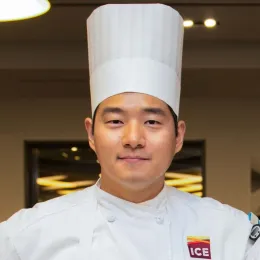
To celebrate 50 years of ICE, we're honoring 50 distinguished ICE alumni. Meet Chef Simone Tong — StarChefs 2019 Rising Star Award winner; former chef/owner of critically acclaimed NYC restaurants Little Tong Noodle Shop and Silver Apricot; and current chef/owner of Southeast Asian-Texas BBQ mashup Sí Baby-Q.
Third culture cooking is a culinary style that produces a singular cuisine by combining multiple global influences — and in restaurants across America, it is thriving. Not to be confused with fusion, third culture cuisine is typically inspired by a more personal, and thus more authentic, point of view.
For ICE 50th anniversary distinguished alumni honoree Simone Tong, third culture cooking is nothing new. She’s been doing it her whole life.
Tong was born in Chengdu, the capital of Western China’s Sichuan Province, but spent much of her childhood moving around Asia Pacific. As such, she was exposed to an array of cuisines and ingredients from an early age.
Tong initially thought she would seek a traditional, corporate job after graduating from college in North Carolina. But when that path proved boring, she pivoted to culinary school and a career in restaurants. The road that followed was winding and occasionally bumpy, but she’s never looked back.
Tong’s first job out of culinary school was working in the restaurant kitchens of culinary legend Wylie Dufresne. She then branched out to open her own critically-acclaimed restaurants in New York — Little Tong Noodle Shop and Silver Apricot — that blended her Chinese heritage with global flavors and French technique. For her efforts, Tong earned a StarChefs Rising Star Award in 2019, and her restaurants landed on “best of” lists from The New York Times and Eater, among others.
After the pandemic and the birth of her first child, Tong and her family moved to Austin, Texas. There, she opened a Southeast Asian-Texas BBQ mashup called Sí Baby-Q wherein she “creates seasonal menus, sources ingredients with intention, and lets them dance and shine in dishes.”
Ever the curious chef, Tong is currently exploring the world of chocolate making with a new venture — Zoé Bonbon.
ICE recently caught up with Tong to check in on living and working in Texas and what it was like to work for one of New York’s most iconic, avant-garde chefs.
Here's what she had to say.
* The following interview has been condensed and edited for clarity.
ICE: When did food become something that you wanted to pursue professionally?
Chef Simone Tong: When I was six, peeling and devouring a whole plate of drunken steamed river shrimp in southern China. And then again, years later, watching PBS After Hours with Daniel Boulud in 2008 — that’s when the spark turned into a fire.

ICE: What have been the hardest things — and also, what have been the most rewarding things — about operating your own restaurants?
Chef Simone: The hardest part is showing up every day with the same energy and optimism — that relentless consistency. The most rewarding thing is watching the back and front of house move as one during a busy service. That harmony is magic.
ICE: How is the culinary scene in Texas different from the culinary scene in New York City?
Chef Simone: Being tested in NYC doesn’t guarantee trust or love in Texas. The palates are different, the sense of adventure is different, and there’s a different level of familiarity with regional flavors. [For example,] how much Sichuan peppercorn is too much? Are they ready to try something unknown?
Still, the equation is the same: honest, delicious food plus humble, genuine service plus the right price point. But achieving that balance is never easy. New York gave me grit, speed, discipline, and most of all, humility. That foundation is everything.

ICE: What does a typical day look like for you now?
Chef Simone: I come in, greet everyone, check the prep list, and jump in where I’m needed. I touch base with the [general manager], check in with the team, take the time to have staff meals with the team and be present at the pre-shift meeting, and then we roll into service. After that, it’s home to tuck the kids into bed.
My favorite days are the ones when the kitchen is humming — everyone in sync, moving as one — and the dining room is full, with every guest well-fed and happy. [I love] bringing people together, whether that’s through a single bite or a full table, and seeing that joy radiate out.
ICE: How do you balance a career in hospitality with family life?
Chef Simone: You don’t really balance it — it’s more of a constant dance. The goal is balance, but life is always a work in progress. For me, staying present is key. Having a good therapist (or two) helps too. You can’t make everything perfect, so you just stay present and live it moment by moment.

ICE: Before you enrolled in culinary school, what was it about ICE that suggested it was a good fit for you?
Chef Simone: The blend of hands-on technique and real-world exposure. Great chef instructors, too! It felt accessible and serious at the same time.
I [also] chose ICE because WD~50 was on their list of restaurants that accept externs. That was the only place I wanted to be. The transition [from culinary school] to real kitchens was intense — faster, louder and more brutal — but I felt prepared to absorb, listen and keep learning.
ICE: What do you consider your biggest professional achievements so far, and to what do you attribute your success?
Chef Simone Tong: De-stereotyping Chinese food in America and nourishing communities through food. Those are the things I’m most proud of. [My success is guided by] the good people who have helped, adopted, and inspired me along the way — guests, sales reps, farmers, butchers, cooks, servers, and chefs. No one succeeds alone.
ICE: Did you have mentors?
Chef Simone: Wylie Dufresne. I staged at WD~50 until he hired me, and I stayed until the very end. The CDC (chef de cuisine) and sous chefs there taught me not just how to cook, but how to be a chef with integrity.
I try to pass that on by mentoring cooks through transparency — sharing everything I know, creating safe spaces to fail and grow. Mentorship is cyclical. It only works if you pay it forward.
ICE: Do you have any advice for people who are considering culinary school?
Chef Simone: Make the most of your access — to chefs, to knowledge, to your classmates. It’s a rare window. Learn to sharpen knives very well. Ask questions. Take notes when you get home. Like any profession, if you want to be great, you have to start by knowing you’re not there yet ... [Success] is not a straight line. Keep showing up. Stay humble. Find mentors who challenge and care for you. And don’t be afraid to change lanes as you grow.

QUICKFIRE QUESTIONS
What is your favorite kitchen tool? Offset spatula.
Salty or sweet? Both — depends on the application and the percentage.
Favorite food holiday? Lunar New Year.
Favorite food city? Impossible to pick just one: NYC, Paris, Tokyo, Chengdu, Bangalore.
In order of preference, cook, bake, eat? Cook, eat, bake.
Favorite cuisine? Chinese for roots, French for technique, Japanese for soul.
Go-to “easy” recipe? Cold noodles tossed with scallions, sesame, garlic, ginger, dried chili, Sichuan peppercorn, black vinegar, sweet soy, and a splash of smoking hot oil.
Go-to “wow” recipe? A dark chocolate bonbon with spiced pu’erh tea ganache and brown rice puff speculoos caramel for crunch.
Most frequently used non pantry essential ingredient? Sichuan peppercorn.
Summer, spring, fall or winter, which one is your favorite food season? Winter.
* Experience varies by student, with outcomes contingent on factors including graduate aptitude, job market, place of residence and work history, among others.