
[VIDEO] Chef Sam Caucci Swapped Spreadsheets for Knives — and Found His Calling


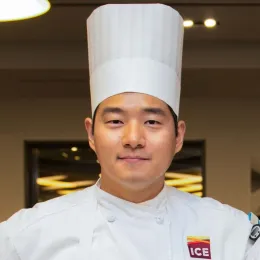
To celebrate 50 years of ICE, we’re honoring 50 distinguished alumni. Meet Chef Sam Caucci, the rising star Sous Chef at New York's SAGA, and one of our 2025 commencement speakers. (Additional ICE NYC commencement speakers were Chefs Missy Robbins and Jacques Torres).
As part of our “Culinary School to Career” video series, we asked Chef Sam about the transition from student to professional chef.
Watch the below video to hear his insights — then read our “Quickfire Q&A” with Chef Sam, wherein he talks about everything from his typical workday to the “soft” benefits of attending culinary school.
In 2018, Samuel Caucci traded spreadsheets for knives. At the time, he was studying economics at St. John’s University, but watching Anthony Bourdain’s iconic PBS show, The Mind of a Chef, convinced him that a fast-paced restaurant kitchen was where he belonged.
Caucci ditched pursuing his economics degree and decided to pursue a culinary career at ICE instead.
An early experience cooking at NYC fine dining restaurant Junoon turned him onto the tough but rewarding world of high-end kitchens. Since graduating, Chef Sam has worked at some of the city’s most distinguished restaurants, including The Modern at The Museum of Modern Art and Clover Hill in Brooklyn, alongside award-winning chef Charlie Mitchell.
Today, Chef Sam is a rising star sous chef at SAGA, the fine dining restaurant founded by chef James Kent, who died in 2024, and is now run by chef Charlie Mitchell.
Earlier this year, Chef Sam spoke to ICE’s graduating class about what it takes to be successful in the restaurant and hospitality industries. We caught up with him after that inspiring speech to ask about his own memories of culinary school.
Here’s what he had to say.
* The following interview has been condensed and edited for clarity.
ICE: What do you consider to be your biggest professional achievements?
Chef Sam: Thus far, [it] would have to be ICE's 50 most distinguished alumni. I think this is such a great honor to hold and I am grateful for the distinction.
ICE: When did food become something that you wanted to pursue professionally?
Chef Sam: My senior year of undergrad, while I was studying economics, I was watching a PBS program called "The Mind of a Chef." Most of the chefs that were featured on the show had similar paths as me. I knew at that moment that a life in corporate America was not the path I was supposed to go down.
I felt like cooking and being a chef was a world with infinite possibilities and would be a career where I could express myself in a creative way. So, after I finished my undergraduate degree, I decided to enroll in the Culinary Arts program at ICE, and I know I made the right decision.
ICE: You graduated Culinary Arts in 2019. A lot has happened in the world and the restaurant industry since then. What do you think are the biggest challenges facing future chefs and restaurateurs?
Chef Sam: Since graduating from ICE in 2019, there have been drastic changes to the industry. I think the biggest challenge has been the rate of retention. Chefs are lucky to keep employees for more than a year. No exact reason for one or the other; but the opportunities and access that are present in the food world [play a role].
ICE: You recently delivered a commencement speech for graduates of the ICE New York campus. Of all the insights in that speech, what is the one thing you’d say to prospective and current culinary students hoping to follow in your footsteps?
Chef Sam: I think the greatest lesson I can teach to prospective and current culinary students is learning humility before you enter this industry. In each place you work, there is a person, whether a chef or a cook, who can teach you something. Don’t underestimate the power of listening rather than speaking. Your chefs will appreciate your ability to listen, rather than giving your opinion on each matter.
ICE: Before you enrolled, what was it about ICE that suggested it was a good fit for you?
Chef Sam: I think ICE was the best fit for my culinary journey because I was able to go to class in the morning and continue to work in the evening. The flexibility of the Institute was helpful for my life at that time.
ICE: Do you have any big takeaways from culinary school?
Chef Sam: The friendships that I made in my class are very rewarding.
ICE: How was the student to real-world transition for you, and was there anything about restaurant work that surprised you?
Chef Sam: [It] was fairly smooth for me. I was working in a restaurant full time when I was in school so I had an advantage over most students. I think the pace of service and speed of prep were the biggest adjustment I had to get used to.
ICE: What’s a typical workday look like for you?
Chef Sam: Arriving at SAGA at noon, possibly a meeting in the afternoon. Prepping from 12:00 p.m. to 4:30 p.m. and then working service from 5:00 p.m. to 11:00 p.m. I usually leave work around midnight or 12:30 in the morning. The days are long but fine dining is a hands-on style of cuisine. It requires a lot of attention and hard work.
ICE: What’s your creative process?
Chef Sam: [It’s] constantly changing. I usually start with one ingredient, and from there, I think about seasonality and what will be available. Mainly, it depends on what has inspired me lately and how I can transform that into my own style or iteration of the dish or technique.
ICE: How do you use mentorship, which is a value that most chefs and people in the industry really care about, especially at a culinary school.
Chef Sam: Mentorship is one of the greatest gifts of this industry. It pushes you to your potential. It guides you. It counsels you in the times you don’t have answers.
My mentor is Chef Barry Tonkinson. He was my instructor in my final module at ICE. He’s taught me — and continues to teach me — about the push of the industry. To keep going especially when times get tough.
ICE: Do you have any advice for people who are considering culinary school?
Chef Sam: The food industry is tough to navigate, but it can be rewarding if you have a great attitude and willingness to learn … Grind in the learning phase, and you will be successful. Become a master of the craft before you take on [other roles].
* Experience varies by student, with outcomes contingent on factors including graduate aptitude, job market, place of residence and work history, among others.