
Dubious About Dubai Bars? Make This Manila Bar Instead

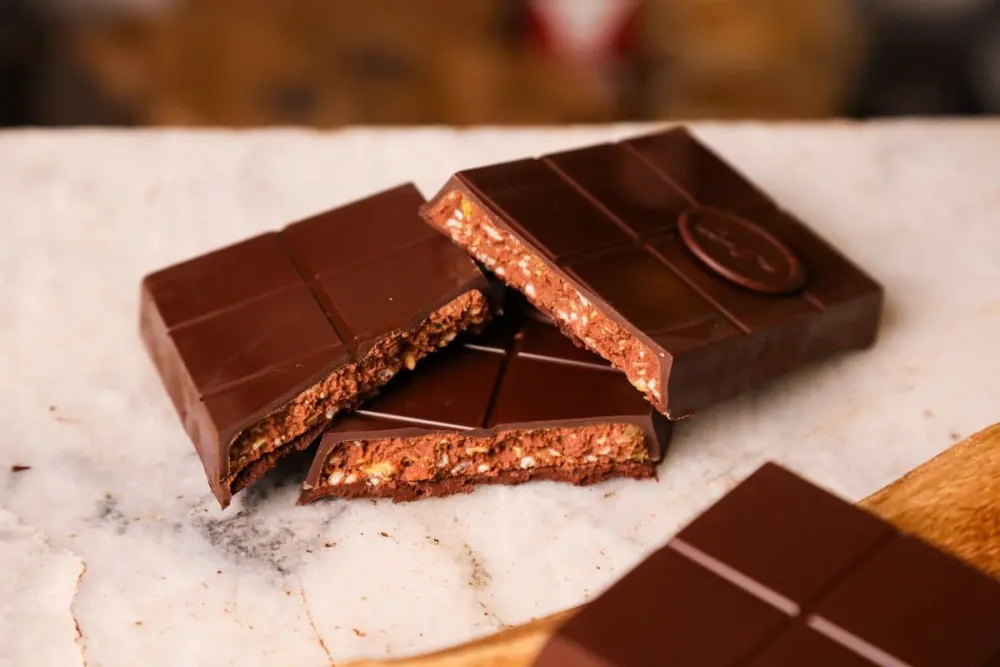
Meet ICE’s new chocolatier, Chef Daniel Corpuz, and get the recipe for his take on the viral Dubai Bar.
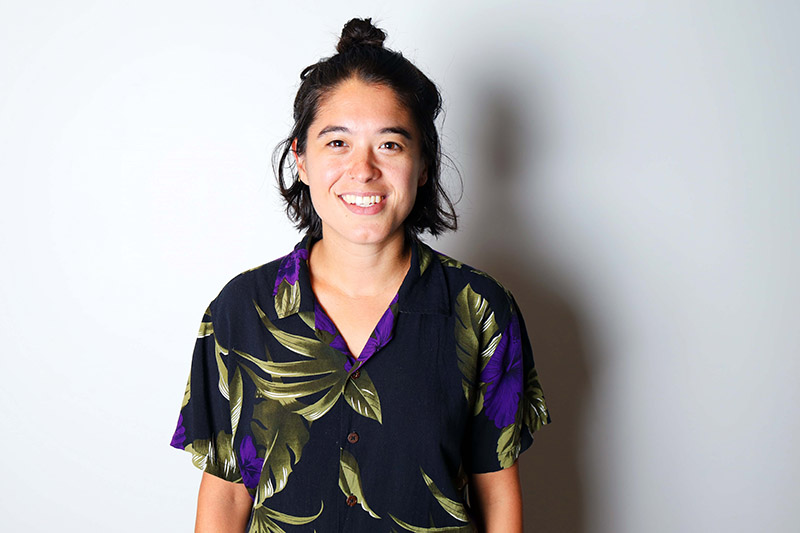
Chef Daniel Corpuz joined ICE's renowned faculty as Creative Director and Chocolatier this month. He is a celebrated baking and pastry arts professional and the owner of Daniel Corpuz Chocolatier. Following a passion for pastry and baking in high school, Chef Daniel graduated from the Culinary Institute of America then honed his craft in the pastry kitchens of several celebrated New York City restaurants — among them The Modern, One White Street and Manhatta.
When COVID forced the city’s restaurants to close, Chef Daniel began experimenting with chocolate at home. This led to an appearance on The Food Network’s ‘School of Chocolate,’ successful pop-ups in NYC, and ultimately, a brick-and-mortar shop in Chinatown. (The latter, pictured below, opened just two months ago.)
Chef Daniel draws on his Filipino heritage and industry experience to infuse Asian flavors into his confections, and that’s exactly how he created the Manila Bar — his take on the trendy Dubai chocolate bar.
So, what does Chef Daniel think of the Dubai Bar? Conceptually, he’s a fan.
“The Dubai Bar plays up what people love when it comes to desserts: chocolate, nuts and crunch — that’s the main concept of it,” he said. It’s a dark chocolate bar with a filling made of pistachio nut paste, white chocolate and kataifi or knafeh.
Developed in 2022 by a pastry chef in Dubai, the bar’s popularity soared in 2024 when TikTok users began sharing images highlighting its vibrant hue and textured layers. More than a year later, it continues selling out despite its hefty price (upwards of $20 a pop). It’s so popular, in fact, that chocolatiers throughout the world and retail brands like Trader Joe’s and Chip City have all launched their own versions of the tasty treat.
So if the bar is that good — and trust me, it is — why does Chef Daniel have reservations about it?
Like the bar itself, the answer is layered and nuanced.
First, it’s a business issue. Chef Daniel’s chocolate shop has an Asian-forward sweets' menu, with flavors like ube, pandan and calamansi featuring prominently in his creations. These flavors pair well with the Dubai Bar, which is why, at the height of its popularity, Chef Daniel’s shop was fielding near daily phone calls from chocolate-lovers eager to buy one. Chef Daniel couldn’t oblige.
His shop is small, he explained, and has just 18 “feature slots” for promoting his own confections. Selling the Dubai Bar would mean displacing one of his own, and with offerings like the lychee pink peppercorn and kumquat jasmine bar, you can see Chef Daniel’s quandary. (Translation: I’ve got a business and a brand and my brand centers on Asian flavors.)
Second, it’s a matter of expectations. Chef Daniel worries that the flavors customers expect in a Dubai Bar are used as the basis for its value (i.e. “This chocolate bar is wildly expensive, but it’s made with three wildly expensive ingredients so it’s worth it”). In short, prospective Dubai Bar customers have been sufficiently exposed to its value proposition, and can now justify its cost based on that proposition.
But, as someone who sells premium chocolates, Chef Daniel also knows that arriving at an understanding of that value proposition can be tough.
“If I were to recreate the Dubai Bar, I would use Valrhona chocolate and pistachios from Sicily or Iran,” says Chef Daniel. These ingredients, like those in the Dubai Bar, are high-quality and expensive. They’re also less well-known than those in the Dubai Bar, making it hard to convince skeptical shoppers of their value.
Third, bad actors are exploiting the Dubai Bar craze — and harming the chocolate industry as a whole. An unpleasant side effect of the Dubai Bar's popularity, says Chef Daniel, is the proliferation of Dubai Bars that use lower quality ingredients while charging higher quality prices. This muddies the waters on value perception and harming consumer trust.
Additionally, some businesses make fewer than 20 bars a day, the result of which is a heightened perception of scarcity, which in turn, inflates the bar’s price.
Fourth, when three ingredients and/or a single product define a country's cuisine, the vastness and variety of its food culture gets lost. For Chef Daniel, who made his own version of the TikTok trending chocolate using traditional Filipino flavors (calling it The Manila Bar), the Dubai Bar frenzy could be reductive if those buying it are unfamiliar with Dubai and its food history.
“[My way] is not the only way to make a Manila Bar,” says Chef Daniel, pointing to the wide variety of Filipino flavors not included in his recipe. He hopes that consumers don’t make the same assumptions as he believes they’ve done with the Dubai Bar; in short, reducing a country’s cuisine to a mere three ingredients.
So what’s the big deal about Dubai Bars?
A chocolate “crunch bar” is nothing new, says Chef Daniel, who, though not an acolyte of the Dubai Bar, acknowledges that its popularity has had some benefits. Specifically, it’s infused the confectionery industry with a dose of creativity, summoning chocolatiers to answer the call, “What exciting thing can you make with chocolate, nuts and crunch?”
For Chef Daniel, the answer is the Manila Bar, which honors his heritage and feels right for the moment. (Philippines Independence Day is Thursday, June 12.)
- For the nut element, he made a cashew-macadamia praline – because both nuts are grown in the Philippines.
- For the crunch, he used green and beige pinipig, a flattened young rice grown in the Philippines and common in Filipino desserts.
- Dark chocolate provides the bar’s shell and dark milk chocolate comprises the filling.
Chef Daniel sells a version of this Manila Bar at his store, which incorporates dried mango and is in the shape of the araw (sun) on the Filipino flag.
You Can Make It At Home
One reason the Dubai Bar has been so popular, concedes Chef Daniel, is that it’s an easy chocolate confection to make at home. His Manila Bar recipe kicks it up a notch, but you’re in for a treat if you give it a shot.
Ingredients
For the Exterior Chocolate Mold
- 1000g 70% dark chocolate (Tropilia-Valrhona)
- 200g 70% dark chocolate (Tropilia-Valrhona)
- 300g cashew-macadamia gianduja (recipe follows)
For the Cashew-Macadamia Gianduja
- 120g pinipig (Green-Young Rice)
- 120g pinipig (Beige-Young Rice)
- 90g 46% milk chocolate (Biahbe-Valrhona)
- 40g cashew-macadamia praline (recipe follows)
- 2g kosher salt
For the Cashew-Macadamia Praline
- 225g macadamia nuts, toasted
- 225g cashew nuts, toasted
- 285g granulated sugar
- 90g water
Directions
For the Exterior Chocolate Mold
- Polish the chocolate molds with a flat cotton pad to ensure no watermarks or residual cocoa butter are on the mold.
- Melt 1000g of dark chocolate over a pot of boiling water. Make sure to mix the chocolate often to prevent burning.
- Once chocolate reaches 45°C, pour 200 grams of dark chocolate into the bowl. (This acts as ‘seed’ to temper the chocolate.)
- Mix chocolate until the seed melts and chocolate reaches 32°C. If all the seed melts but the chocolate hasn’t reached 32°C, add additional seed to properly temper the chocolate.
- Once chocolate is tempered, pour into cavities of the mold to the top.
- Using the end of a chocolate scraper, tap the side of the mold to shake out any air bubbles.
- After tapping 15-30 seconds, flip mold upside down over a table with parchment paper.
- Tap side of mold with end of chocolate scraper to knock out any residual chocolate.
- Scrape the mold of any chocolate that remains on the sides of the cavities.
- Set the mold, still upside down, on a clean sheet of parchment and let chocolate crystallize.
- Prepare Cashew-Macadamia Gianduja filling, and cool to 30-32°C.
- Once chocolate in mold crystallizes, fill cavities with 90-95g of filling.
- Using a miniature offset spatula, spread filling into corners and level out. (Be sure to leave a 3-5mm space for the bottom layer of chocolate.)
- Let filling crystallize at least 6 hours or overnight.
- Once filling has crystallized, re-temper a bowl of chocolate (steps 2-4).
- Heat edges of bar using a heat gun or hair dryer on warm setting.
- Pour tempered chocolate over filling to create a ‘cap’ and seal chocolate bars.
- Let final layer crystallize in a cool setting or fridge.
- Once cooled and crystallized, flip mold onto clean surface to release bars from mold.
For the Cashew-Macadamia Gianduja
- Toast pinipig rice in 325°F oven at least 15 minutes. Check on nuts every 5 minutes until majority of rice is puffed and light golden brown.
- Melt milk chocolate over a pot of boiling water. Make sure to mix the chocolate often to prevent any burning.
- Once chocolate is fully melted, mix praline into chocolate until homogenous.
- Mix toasted pinipig into gianduja.
- Add salt.
- Taste filling and add additional salt or pinipig as desired (for more salt or texture).
- Place bowl in fridge and cool to 31-32°C.
- Use filling in that temperature range, reheat and cool down as needed.
For the Cashew-Macadamia Praline
- Weigh nuts separately and place them on separate baking sheets.
- Toast nuts in 325°F oven at least 15 minutes. Check nuts every 5 minutes until each nut is golden brown. (The macadamia nuts will take longer to toast, as commercially bought cashews are already toasted.)
- As nuts are toasting, combine sugar and water in 2-quart sauce pot and heat over medium to high heat. Mix to combine into a syrup.
- Continue to boil sugar until it’s a light amber color.
- Pour hot caramel onto flat surface lined with silicone mat. Spread caramel to 6-8mm thick to ensure it’s easy to break apart. Let cool.
- Once nuts are toasted and while still warm, blend them in a food processor on high speed until liquified. Once liquified, transfer nut paste into a bowl.
- Blend hardened and cooled caramel in food processor until it becomes a fine powder.
- Add nut paste and blend on high until homogenous. (If you’re aiming to have a fully smooth paste, transfer the praline into a melanger and let the melanger run for a minimum of 4 hours.)