
Make This Mexican Hot Chocolate Recipe — and Learn Its History

Chocolate can be traced back thousands of years to the Olmec, Mayan and Aztec cultures — and its first form was a beverage.
If I asked you to describe chocolate’s physical characteristics, you might think of a dark, shiny, brittle bar that slowly melts in the mouth. You also might associate its rich flavor with brownies and creamy bonbons.
You wouldn’t be wrong — chocolate has found its way into countless applications. It’s a sweet shape-shifter that pairs perfectly with our favorite flavors.
This, however, hasn’t always been the case.
The modern chocolate bar didn’t emerge until technology and innovation converged in the mid-1800s. When Dutch chemist Casparus van Houten developed the cocoa butter press in the 1820s, he was originally after the pressed solids — the cocoa butter (the fat that makes up over 50% of a cocoa bean) was merely a by-product.
It would be many years before a chocolate maker (most likely the Fry family in England) came up with the idea to combine the leftover cocoa butter with sugar and add it back into ground cocoa beans.
At this point, chocolate began to resemble the treat we now know and love, though its texture and flavor continued evolving during the Industrial Revolution and subsequent decades.
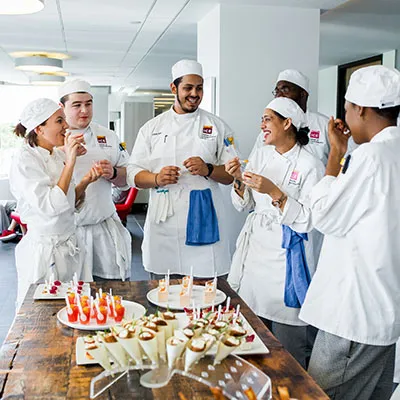
Today, chocolate is an art form for pastry chefs across the globe. In fact, ICE’s Pastry & Baking Arts program dedicates an entire course to chocolate, covering production, theory and tempering methods. Students gain hands-on experience with essential techniques for working with chocolate, ranging from simple confections to elaborate showpieces. (Those studying at ICE New York also have access to the school’s Chocolate Lab, where they can gain volunteer experience and see the full bean-to-bar process.)
But let’s go back to the beginning.
Mesoamerican Origins
The history of chocolate can be traced back to the Olmec, Mayan and Aztec cultures of present-day Mexico and Central America. At this time, chocolate was a beverage.
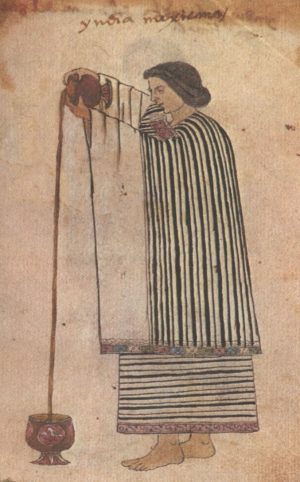
These early chocolate makers cultivated the cacao tree, ultimately rendering the seeds of its fruit (the bean) into a drink. What these cultures enjoyed bore little resemblance to a Swiss Miss package. For starters, it likely wasn’t sweetened or served hot; rather, it was made with water, flavored with spices and flowers, and frothed with repeated pouring from one vessel into another.
The beans themselves were a significant staple crop and greatly valued, though most historians suggest their consumption was not prolific. Instead, they were used primarily for medicinal and ceremonial purposes.
Most culinary applications — even savory mole — appeared much later. After the Spanish conquered the birthplace of chocolate in the 1500s, chocolate would undergo further changes as it made its way across the Atlantic.
Chocolate’s Journey From the Americas to Spain
The first Spanish conquistadors to adapt the Aztec beverage were likely missionaries tasked with “converting” indigenous people. By the time chocolate made its way to Spain, it had evolved into something akin to a cappuccino — a drink served warm, sweetened and whipped to a froth using a wooden molinillo. As chocolate’s popularity slowly spread throughout Europe, it was still not a drink for the masses — but instead, a treat for nobility.
As chocolate’s popularity trickled down to the general public, it became a beverage on par with tea and coffee. This growing demand led to its cultivation in European colonies with tropical climates conducive to cacao’s production. Nonetheless, chocolate remained something to drink (not eat).
Chocolate’s Transformation in the 1800s and Beyond
Fast forward to 1820, when van Houten developed the cocoa press. His goal was to remove cocoa butter from chocolate’s preparation to create a lighter beverage (with much of the fat removed). This beverage was called digestible cocoa, and as it became widely accessible, it was consumed in the morning or afternoon as a pick-me-up.
At the time, chocolate was also touted for various health benefits and considered a gentler alternative to its cousin, coffee. As chocolate culture progressed, it did, of course, find its way into bar form (and then confections and baked goods) in the mid-1800s. By the turn of the 20th century, cocoa and chocolate were firmly embedded in our daily regimen.
"Chocolate has found its way into countless applications. It’s a sweet shape-shifter that pairs perfectly with our favorite flavors." - Chef Michael Laiskonis
A Hot Chocolate Recipe with Ancient Origins
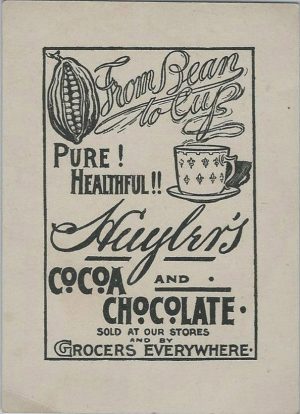
There’s so much more to learn about chocolate’s history. My own research has led to some interesting discoveries: colorful Victorian-era cocoa tins decorated with imagery of cacao pods, and even references to “bean-to-cup” — a term that foreshadowed the “bean-to-bar” phrase we use more than a hundred years later.
With all this research into this magical bean, I’m craving a frothy cup of hot chocolate.
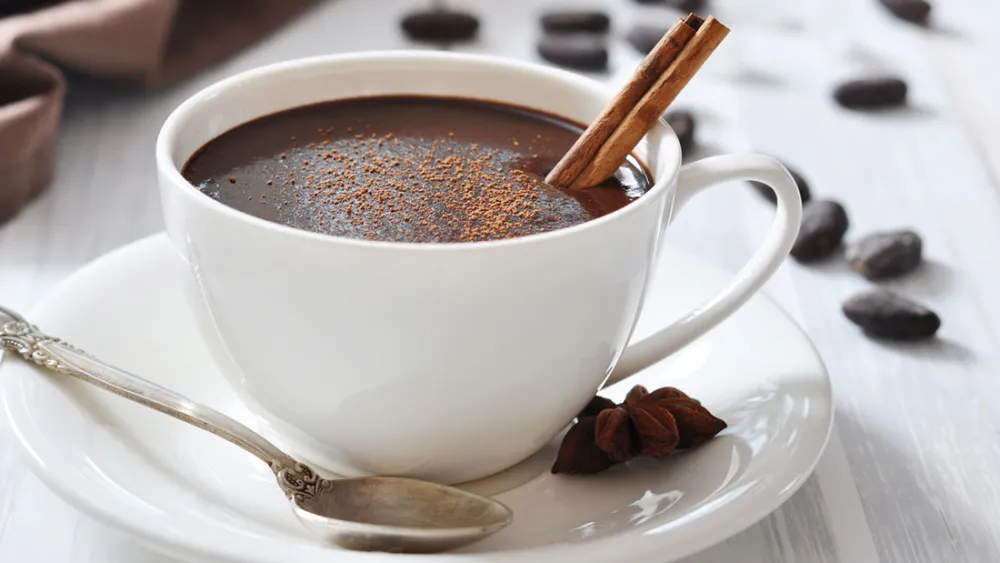
Here is my favorite modern recipe, inspired by Mexican hot chocolate. It is deep in chocolate flavor with subtle accents of unrefined sugar, warm spices and a touch of heat from dried smoked chile.
For more on chocolate education, check out ICE’s Pastry & Baking Arts program and request information here.

Ingredients
- 1 quart (950 grams) whole milk
- ¼ cup (60 grams) heavy cream
- 1 cup (200 grams) grated panela, piloncillo or light brown sugar
- ½ teaspoon (2 grams) salt
- 2 sticks whole cinnamon
- 2 pieces whole star anise
- ½ teaspoon (2 grams) powdered chipotle morita (or to taste)
- 1 vanilla bean, split & scraped
- 7 ounces (200 grams) dark chocolate, roughly chopped
Directions
- Combine milk, cream, sugar, salt, spices, vanilla seeds and bean in a medium saucepan and bring to a boil over medium heat. Reduce heat to low and hold at a bare simmer, stirring occasionally, 5 minutes.
- Whisk in chocolate and simmer 5 minutes. Remove vanilla bean and whole spices. Blend well with an immersion blender to create a froth, serve immediately.